
How a garage door spring works
A garage door spring balances the door's weight, so the opener only has to nudge it. When a spring breaks, the door becomes dead weight. See how it works in the 3D model below. Door just banged and won't open? Don't lift it or pull the red release cord. Keep everyone clear and call a garage door technician. Check what broke.
3D garage door model
Red means high tension
A single-car garage door, seen from inside. The parts in red are under high tension: the spring, the cable drums, the lift cables, the bottom brackets and the brackets that hold the bar. (The red cord hanging from the opener is the release cord, not a tension part.) Tap Next to see each part close up, or drag the picture to look around.
The spring is wound tight
With the door closed, the spring on the bar above it is twisted about 7½ full turns on a 7-foot door. We've drawn a yellow stripe on it so you can see the twist.
Opening the door unwinds the spring
We've made the door see-through so you can watch the spring. As the door goes up, the drums turn and wind the cables on, and the spring unwinds. Its pull drops as fast as the weight left hanging on the cables, so the door needs only a nudge. Lifting is the spring's job, not the opener's.
A balanced door stays put
With the opener disconnected, a balanced door you let go of halfway open stays where it is. That's the balance test in our guides, and it's only ever started with the door fully closed and nothing looking broken.
A worn spring lets it sink
A worn spring pulls less than the door weighs, so the door feels heavy and drifts down. Only a trained technician should adjust or replace a spring.
Bang: the spring breaks
A breaking spring can make a loud bang, like a gunshot. Look for a gap of 2 to 3 inches in the coil. Now nothing balances the door's weight, and the opener isn't built to lift it alone.
Why you never lift it now
This is what happens if someone lifts the door, or pulls the red release cord, when a spring is broken: an open door can fall fast and without warning. So don't lift it, don't pull the red release cord, and keep people and cars clear.
What do you notice?
Pick the closest one, and the model shows what's most likely going on to see what's most likely going on. Look from the floor: don't touch the springs, cables or brackets to check.
This is a guide to the likely cause, not an inspection of your door. If anything looks broken or you're unsure, keep clear and call a trained technician.
Safe checks you can do
Three checks from DASMA's checklist for homeowners and inspectors. Do the first two every month, only on a door that runs normally and hangs level. The balance test opens after a quick look-first check.
Never adjust or loosen the springs, cables, drums or brackets yourself: they're under high tension, and DASMA says to leave them to a trained technician. We're a guide, not a repair company.
Moving the slider is like holding the door by hand, with the opener disconnected. Then let go and watch the door in the model.
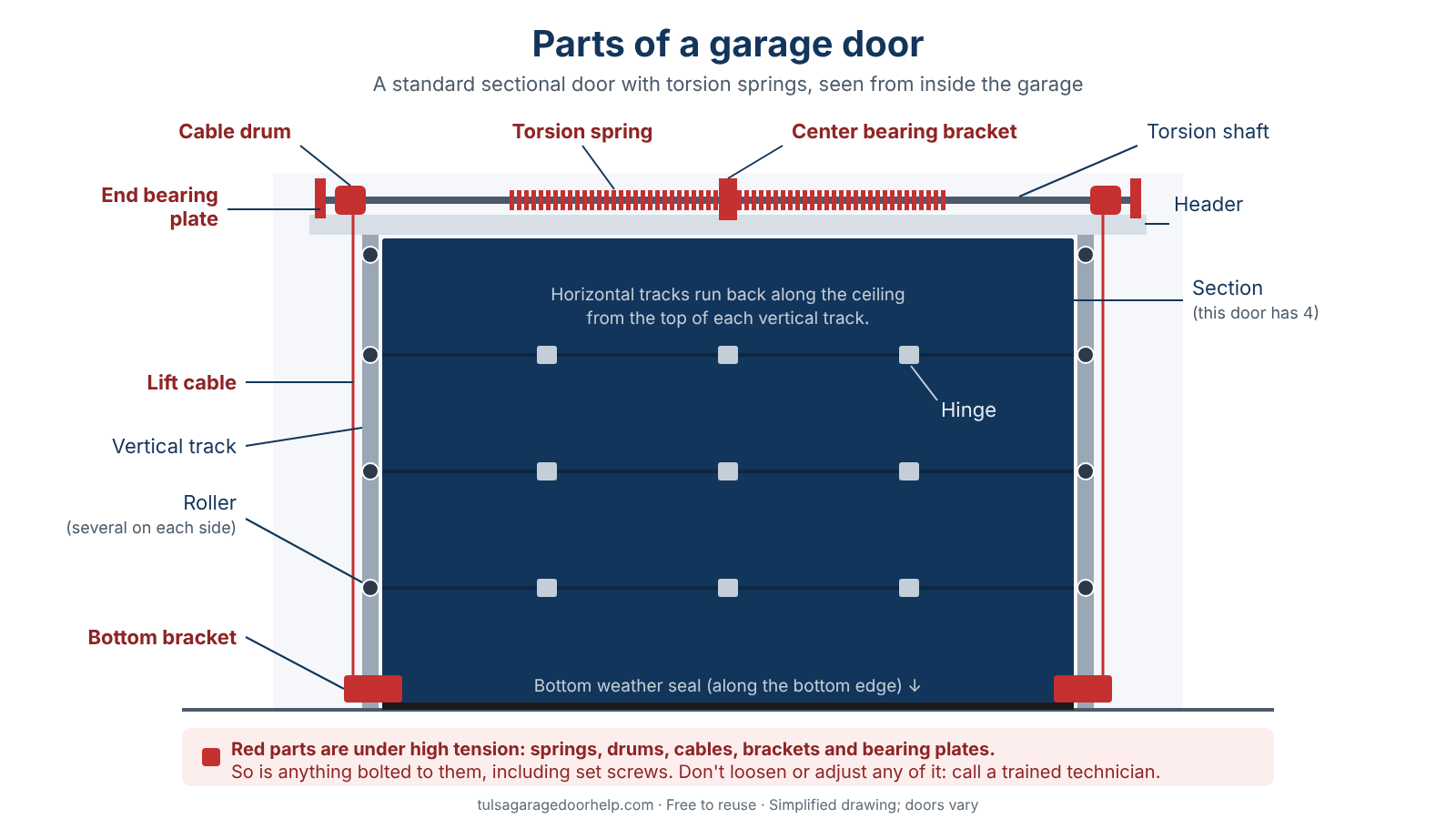
Loading the 3D model…
Share of the door's weight
Your browser can't show the 3D model, so here is the same door as a labeled drawing. Everything the model shows is explained below.
Stop using the door until it's fixed
Most likely
Broken torsion spring (the coil above the door)
Also possible: broken extension spring (the long spring beside the upper track).
The model shows a broken torsion spring: a gap in the coil, and no lift left for the door.
What to do
- Stop pressing the remote or wall button. If the door is closed, leave it closed. If it's stuck part-way open, don't close or lift it: keep everyone clear.
- If you can reach the opener's plug without a ladder and without standing under the door, unplug it so nobody runs it by accident. A backup battery can still run it, so don't press any button.
- Look at the springs from the floor, without touching them, to see which kind broke.
- Call a trained door technician and say whether it is a spring above the door or beside the track.
Don't
- Do not pull the red release cord or try to lift the door by hand.
- Do not touch, loosen or try to replace the spring, cables or bottom brackets.
- Do not keep running the opener to force the door up.
Typical repair: replacing the torsion springs (a complete set) is $350–$540 installed; extension springs are $300–$400 (This Old House, updated Mar 10, 2026). National ranges, not a Tulsa quote.
All the causes, steps and sources for this problem · Read the guide · How to check a garage door company
Sources: Clopay: Awww, Snap! Do I Have a Broken Garage Door Spring?; Chamberlain Group: What to Do When Your Garage Door Makes Noises; DASMA: TDS 167: Residential Sectional Garage Door & Electric Operator Checklist for Home Inspectors and Consumers; Clopay: Understanding Garage Door Springs: Types, Functions and Maintenance Tips
Stop using the door until it's fixed
Most likely
The spring above the door (a torsion spring) has broken
Also possible: on a two-spring door, the other spring is worn and near the end of its life too.
The model shows a broken torsion spring: a gap in the coil, and no lift left for the door.
What to do
- If the door is closed, leave it closed. If it's open at all, don't close or lift it: keep everyone and cars out from under it. If you can reach the opener's plug without a ladder and without standing under the door, unplug it so nobody runs the door by accident. A backup battery can still run it, so don't press any button.
- Check from the floor whether the door has one spring or two, so you can tell the technician.
- Book a trained door technician for spring replacement.
Don't
- Do not operate the door with a broken spring.
- Do not pull the red release cord: a door with a broken spring can drop.
- Do not try to wind, loosen or swap the spring yourself.
Typical repair: replacing the torsion springs (a complete set) is $350–$540 installed (This Old House, updated Mar 10, 2026). National ranges, not a Tulsa quote.
All the causes, steps and sources for this problem · Read the guide · How to check a garage door company
Sources: Clopay: Awww, Snap! Do I Have a Broken Garage Door Spring?; Chamberlain Group: Garage Door Opener Diagnostic Codes; DASMA: Safety Tips; Clopay: Clopay residential garage door care and maintenance brochure (RSDR-CRCAREMAINTBR)
Stop using the door until it's fixed
Most likely
A door spring is broken, so the opener cannot lift the weight
Also possible: the door's own lock or slide bolt is engaged; the sliding part on the rail is jammed against the bolt at one end.
The model shows the opener straining against a door it can't lift, then the reason: a broken torsion spring, with a gap in the coil.
What to do
- Stop pressing the button; repeated tries can overheat the motor.
- Look at the springs from a distance for a gap in the coil. Only if they look whole and the door is closed and hangs level, check the door's slide lock is open.
- Look where the sliding part (trolley) sits on the rail and whether it is jammed at one end.
- Broken spring, hanging cable or crooked door? Leave the door where it is, keep out from under it, call a technician.
- In any of those cases, if you can reach the opener's plug without a ladder and without standing under the door, unplug it so nobody runs the door by accident. A backup battery can still run it, so don't press any button.
Don't
- Do not pull the red release cord.
- Do not open the opener's cover; the parts inside are for a technician.
- Do not touch, adjust or try to replace springs or cables.
- Do not try to lift the door if a spring looks broken or the door is crooked.
Typical repair: replacing the torsion springs (a complete set) is $350–$540 installed (This Old House, updated Mar 10, 2026). National ranges, not a Tulsa quote.
All the causes, steps and sources for this problem · Read the guide · How to check a garage door company
Sources: Chamberlain Group: Why does my garage door opener hum but the door does not move; Chamberlain Group: How do I get the trolley off the stop bolt or stop tab; Chamberlain Group: What does the flashing LED next to the learn button mean; Chamberlain Group: How to Manually Open or Close a Garage Door
Stop using the door until it's fixed
Most likely
Springs are weak or broken, so the door is out of balance
Also possible: door was released from the opener while open.
The model shows a worn spring that pulls less than the door weighs, so the door sinks when it's let go. A broken spring would let it drop fast.
What to do
- Keep people, pets and cars out from under the door.
- If the door is down, leave it down. If you can reach the opener's plug without a ladder and without standing under the door, unplug it so nobody runs the door by accident. A backup battery can still run it, so don't press any button.
- If it is up or propped, leave it as it is, keep everyone clear and call a technician now.
- Call a trained door technician and say the door will not stay open.
Don't
- Do not prop the door open and walk under it.
- Do not pull the red release cord.
- Do not adjust the springs or cables to make it hold.
If it needs new springs: typically $350–$540 installed for torsion springs, $300–$400 for extension springs (This Old House, updated Mar 10, 2026). Ask for any price in writing first. National ranges, not a Tulsa quote.
All the causes, steps and sources for this problem · Read the guide · How to check a garage door company
Sources: DASMA: TDS 174: Building Occupant - Checking a Garage Door for Damage; Chamberlain Group: How to Manually Open or Close a Garage Door; Clopay: Understanding Garage Door Springs: Types, Functions and Maintenance Tips; Chamberlain Group: Error Code 1-6 - Chamberlain Support; Chamberlain Group: Garage Door Opener Diagnostic Codes
Stop using the door until it's fixed
Most likely
Broken spring, so nothing is carrying the door's weight
Also possible: springs have weakened and the door is out of balance; door is binding in the tracks or on dry rollers and hinges.
The model shows a broken torsion spring: a gap in the coil, and nothing left carrying the door's weight. Weak springs feel heavy too, just less so.
What to do
- If the door is down, leave it closed. If it is up and too heavy to control, keep clear and call a technician.
- Look at the springs and cables from the floor for anything broken or loose.
- If you can reach the opener's plug without a ladder and without standing under the door, unplug it so nobody runs the door by accident. A backup battery can still run it, so don't press any button.
- Reconnect the opener only after a technician confirms the door is balanced.
- Call a trained door technician and describe how heavy it felt and whether it was sudden.
Don't
- Do not keep lifting a door that feels unusually heavy; it can fall.
- Do not adjust springs, cables or bottom brackets to make it lighter.
- Do not pull the red release cord.
Typical repair: replacing the torsion springs (a complete set) is $350–$540 installed (This Old House, updated Mar 10, 2026). National ranges, not a Tulsa quote.
All the causes, steps and sources for this problem · Read the guide · How to check a garage door company
Sources: Clopay: Understanding Garage Door Springs: Types, Functions and Maintenance Tips; Chamberlain Group: How to Manually Open or Close a Garage Door; Genie: How to Check If Your Garage Door Is Balanced; DASMA: TDS 174: Building Occupant - Checking a Garage Door for Damage; Chamberlain Group: How to test the balance of a garage door
Get it looked at soon
Most likely
Door is out of balance: the springs no longer carry its weight
Also possible: one of two springs has broken.
The model shows a worn spring that pulls less than the door weighs, so the door sinks when it's let go. A broken spring would let it drop fast.
What to do
- Look at the springs from the floor without touching them, and note whether the door drifted slowly or fell fast.
- A gap in a spring, or a fast fall? Stop using the door, keep everyone and cars out from under it, and call a technician now.
- Springs whole and a slow drift? Lower it gently to the floor by its handle, feet clear and nobody under it, and leave it closed. Don't reconnect the opener until a technician has rebalanced it; book one this week.
Don't
- Do not adjust the springs yourself to correct the balance.
- Do not ignore it: an unbalanced door may not reverse when it should.
- Do not pull the red release cord.
If it needs new springs: typically $350–$540 installed for torsion springs, $300–$400 for extension springs (This Old House, updated Mar 10, 2026). Ask for any price in writing first. National ranges, not a Tulsa quote.
All the causes, steps and sources for this problem · Read the guide · How to check a garage door company
Sources: Chamberlain Group: How to test the balance of a garage door; Genie: How to Check If Your Garage Door Is Balanced; Clopay: Clopay residential garage door care and maintenance brochure (RSDR-CRCAREMAINTBR); DASMA: Safety Tips; DASMA: Automatic Garage Door Opener Safety & Maintenance Guide
Stop using the door until it's fixed
Most likely
Lift cable has jumped off its drum or pulley
Also possible: cable is frayed or has snapped from wear; a spring broke and the cables lost tension.
The model shows the left lift cable off its drum. That side of the door drops, and the door hangs crooked.
What to do
- Stop using the door. If you can reach the opener's plug without a ladder and without standing under the door, unplug it so nobody runs the door by accident. A backup battery can still run it, so don't press any button.
- Keep everyone clear of the door, especially if it is partly open.
- Look from a distance and note which side and whether the door is level.
- Call a trained door technician for cable repair.
Don't
- Do not operate the door or pull the red release cord.
- Do not try to rewind the cable or put it back on the drum or pulley.
- Do not touch the bottom corner brackets the cables attach to.
Typical cable repair: $100–$350 (Angi, garage door cable repair cost (2025 data)). National ranges, not a Tulsa quote.
All the causes, steps and sources for this problem · Read the guide · How to check a garage door company
Sources: Clopay: Common Garage Door Repairs: What You Need to Know; DASMA: TDS 174: Building Occupant - Checking a Garage Door for Damage; DASMA: Safety Tips; Clopay: Emergency Garage Door Service; Raynor Door Company: How to fix a snapped garage door cable
Stop using the door until it's fixed
Most likely
Lift cable is off its drum, loose or broken on the low side
Also possible: rollers have come out of the track on one side; one extension spring is broken or its pulley is worn.
The model shows the left lift cable off its drum. That side of the door drops, and the door hangs crooked.
What to do
- Stop the door where it is. If you can reach the opener's plug without a ladder and without standing under the door, unplug it so nobody runs the door by accident. A backup battery can still run it, so don't press any button.
- Keep people away. Do not walk or drive under it, even to move a car.
- Take photos of both sides from a safe distance for the technician.
- Call a trained door technician and say the door is crooked.
- Stuck open overnight? Lock the door from the garage into the house and ask for an emergency visit.
Don't
- Do not run the opener to straighten it.
- Do not pull the red release cord on a crooked door.
- Do not push, pry or hammer the door back into the track.
Typical cable repair: $100–$350 (Angi, garage door cable repair cost (2025 data)). National ranges, not a Tulsa quote.
All the causes, steps and sources for this problem · Read the guide · How to check a garage door company
Sources: Clopay: Common Garage Door Repairs: What You Need to Know; Clopay: Emergency Garage Door Service; Clopay: Why Garage Doors Get Stuck - Causes & Fixes; DDM Garage Doors: Garage Door Troubleshooting Guide: Causes & Solutions
Stop using the door until it's fixed
Most likely
Extension spring has broken
Also possible: extension spring is worn out and has lost its pull; pulley or cable on that side has failed, letting the spring go slack.
The model switches to extension springs, the long springs above each track, and shows one broken. Each should have a safety cable running through it; if yours has none, stay well clear of the spring's line.
What to do
- Leave the door closed and keep away from the spring's line of travel. If it is open, keep people and cars out from under it.
- If you can reach the opener's plug without a ladder and without standing under the door, unplug it so nobody runs the door by accident. A backup battery can still run it, so don't press any button.
- Check from a distance whether a safety cable runs through the middle of each side spring.
- Call a trained door technician; expect both side springs to be replaced together.
Don't
- Do not operate the door with a broken or hanging spring.
- Do not unhook, re-hook or stretch the spring back into place.
- Do not pull the red release cord.
Typical repair: replacing the extension springs (a complete set) is $300–$400 installed (This Old House, updated Mar 10, 2026). National ranges, not a Tulsa quote.
All the causes, steps and sources for this problem · Read the guide · How to check a garage door company
Sources: Clopay: Awww, Snap! Do I Have a Broken Garage Door Spring?; DASMA: Safety Tips; Genie: Maintaining Your Garage Door; DDM Garage Doors: Garage Door Troubleshooting Guide: Causes & Solutions
Stop using the door until it's fixed
Most likely
The door was bumped by a car or another heavy object
Also possible: track brackets worked loose or the track bent; worn or broken rollers.
The model shows the left side of the door out of its track, leaning into the garage.
What to do
- Stop using the door and the opener straight away.
- If you can reach the opener's plug without a ladder and without standing under the door, unplug it so nobody runs the door by accident. A backup battery can still run it, so don't press any button.
- Keep people, pets and cars away. Do not walk or drive under the door, even to move a car.
- Call a garage door technician to reset the door and check cables and track.
- If a car hit the door, tell your auto and home insurers, as Garaga suggests.
Don't
- Do not force the rollers back into the track or try to repair it yourself.
- Do not keep pressing the opener button or pull the red release on a crooked door.
- Do not touch a loose cable, the bottom brackets or the springs.
Typical repair: most garage door repairs are $98–$371 (This Old House, updated May 29, 2026). National ranges, not a Tulsa quote.
All the causes, steps and sources for this problem · Read the guide · How to check a garage door company
Sources: Garaga: Why did my garage door come off its tracks?; Raynor Door Company: How to Handle an Off-Track Garage Door Safely; Clopay: Clopay 905/906 installation and maintenance manual
Get it looked at soon
Most likely
Door is disconnected from the opener (red release was pulled)
Also possible: chain or belt is broken or has come off its wheel; worn-out drive gear or broken chain wheel inside the motor unit.
The model shows the opener's carriage moving along the rail while the door, released from it, stays put. Check the spring above the door before anything else.
What to do
- Watch whether the chain, belt or screw moves while the motor runs.
- Door open and released? Close it by hand only if the springs and cables look whole, the door is straight, and it is standing still on its own. Don't test it by lifting. If not, leave it, keep clear and call a technician.
- Door fully closed? First look from the floor. If the springs and cables look whole and the door hangs level, reconnect it as your manual shows and run one full cycle, standing beside the doorway, not under it. If anything looks broken or crooked, leave it released and call a technician.
- If the chain or belt is broken or the motor only grinds, stop using it. If you can reach the opener's plug without a ladder and without standing under the door, unplug it, then call a technician. A backup battery can still run it, so don't press any button.
Don't
- Red release cord: only with the door fully closed. Never with a broken spring, loose cable or crooked door.
- Do not keep running an opener that is grinding.
Often free: if the door is simply released, reconnect it once it is fully closed and the springs and cables look whole, as your manual shows. If the opener itself needs a repair: typically $124–$368 (HomeAdvisor (no date shown)). National ranges, not a Tulsa quote.
All the causes, steps and sources for this problem · Read the guide · How to check a garage door company
Sources: Genie: Genie Garage Door Opener Troubleshooting Guide - for models 1022, 1024, 1042, 2022, 2024, 2042, 2027; Chamberlain Group: Why does my garage door opener hum but the door does not move; Chamberlain Group: How to Manually Open or Close a Garage Door; Chamberlain Group: What does the flashing LED next to the learn button mean; This Old House: How to Repair a Garage Door Opener
Get it looked at soon
Most likely
10 flashes on Chamberlain/LiftMaster: safety sensor problem
Also possible: 5 flashes and a beep: the door hit something or met resistance; 2 flashes: the LOCK button on the wall control is on.
The model shows a storage bin blocking the safety sensors' beam: the door starts down, goes back up, and the opener light flashes.
What to do
- Count the flashes and note whether the opener also beeps.
- Clear the doorway and check that both floor sensor lights are steady.
- If the wall control lock light is on, turn LOCK off and try again.
Don't
- Do not bypass or disconnect the sensors.
- Do not keep forcing the door closed by remote while it is hitting something.
Often free: clear the doorway and re-aim the sensors. The steps are in our sensor guide.
All the causes, steps and sources for this problem · Read the guide · How to check a garage door company
Sources: Chamberlain Group: Garage Door Opener Light Blinks but The Door Won't Close; Chamberlain Group: My Garage Door Will Not Fully Close; Chamberlain Group: What does the flashing LED next to the learn button mean; Chamberlain Group: Chamberlain B500, B503, B510 owner's manual (safety sensors and sleep mode)
Monthly test
The 2x4 reverse test
A closing door must back off when it hits something. CPSC, Chamberlain and the International Door Association set a monthly or 30-day interval. Only on a door that runs normally and hangs level, with no broken spring or loose cable.
How to do it
- Open the door, and keep people, pets and cars out of the doorway.
- Lay a 2x4 flat on the floor, in the middle of the doorway.
- Stand to the side, clear of the doorway, and close the door with the wall button. When it touches the board, it should stop and go back up.
If it fails: If the door stops on the board or keeps pushing, press the wall button to send it back up. Then stop using the opener until it's adjusted the way its manual says, repaired or replaced. If it keeps failing, Chamberlain says to call a trained technician. Don't pull the red cord unless the door is fully closed.
Sources: Chamberlain Group support: how to test the safety reversal system; DASMA: Paper towels vs. 2x4s (Chamberlain's Barbara Kelkhoff, Fall 2004): test the reversal monthly, with a 2x4 laid flat; CPSC Publication 523; Chamberlain Group support: does my garage door opener need monthly or annual maintenance?; International Door Association: garage door safety and maintenance; DASMA Technical Data Sheet #167 (revised Apr 2023): garage door and opener checklist for home inspectors and consumers.
Monthly test
The sensor test
The two small sensors near the floor send a beam across the doorway. If anything breaks the beam while the door closes, the door should go back up. Do it right after the 2x4 test, only on a door that runs normally and hangs level, with no broken spring or loose cable.
How to do it
- Open the door.
- Press the wall button once to close it (don't hold it down), and from the side, pass something long, like a broom handle, through the beam near the floor. Don't step into the doorway.
- The door should stop and go back up. Many openers also flash their light.
- While you're there: the sensors should sit no more than 6 inches above the floor.
If it fails: The door keeps closing with the beam blocked? Stop using the opener and call a trained door technician. First check the sensors sit no more than 6 inches up, so the handle really crossed the beam. A door that won't close at all is a different problem: see our sensor guide.
Sources: DASMA Technical Data Sheet #167 (revised Apr 2023): garage door and opener checklist for home inspectors and consumers; Chamberlain 1345M owner's manual: test the protector system (manual copy); Chamberlain Group support: how to test the safety reversal system; Chamberlain Group support: does my garage door opener need monthly or annual maintenance?; International Door Association: garage door safety and maintenance.
Look first
The balance test
A balanced door stays where you leave it, because the springs carry its weight. This test means pulling the red release cord, so it's only safe when the springs and cables are whole and the door is closed.
Stop here. Don't pull the red release cord or lift the door. Keep everyone clear and call a trained technician. A door with a broken spring or cable is dead weight, and it can fall. A crooked or off-track door can come loose.
Why is pulling the cord OK here, but not with a broken spring? Here the door is closed, so releasing it can't let it fall, and you lift it only a few inches first to feel whether the springs carry it. With a broken spring or cable, the door is dead weight: once it's off the floor it can drop, and an open door can fall the moment the cord is pulled.
How to do it
- Make sure no people, pets or cars are in the doorway. Keep remotes out of reach and don't press the wall button: on many openers that reconnects the door. With the door fully closed, pull the red release cord the way your opener's manual shows (on many, straight down) to disconnect the opener.
- Lift the door a few inches first, using the handle at the bottom. If it's heavy or hard to move, lower it and stop.
- If it moves easily, lift it slowly to about 3 to 4 feet. Keep your hands off the joints between the panels.
- Ease your hands off slowly, feet clear. If it stays put or moves only a little, the balance is fine.
- Only if it passed: close it fully and reconnect the opener the way your manual shows (reconnect steps by brand).
If it fails: Starts to sink or rise as you ease off? Keep your hands on the handle, lower it gently to the floor, feet clear, and stop. If it slams down or shoots up, don't try to catch it: keep clear. Either way, a technician should check the springs. Don't run the opener until then, and don't keep repeating the test.
Sources: DASMA Technical Data Sheet #167 (revised Apr 2023): garage door and opener checklist for home inspectors and consumers; Chamberlain Group support: how to test the balance of a garage door; Chamberlain Group support: How to manually open or close a garage door; DASMA Technical Data Sheet #174 (rev. Apr 2017, reaffirmed 2019): checking a residential sectional garage door for damage; Genie: how to check if your garage door is balanced (Oct 25, 2021).
What the spring does
A garage door is heavy. The spring is there to balance its weight, so the door is easy to lift; DASMA, the door and opener makers' association, says the springs "counteract the door weight" and that the opener "should not have to do the heavy lifting" (DASMA Tech Corner, Door + Access Systems magazine, Winter 2025: garage door balance). A standard torsion spring "holds 100 to 300 pounds of force", and the opener "is not designed to lift the full door weight without spring assistance" (Raynor Door Company (a Chicago-area garage door dealer), May 25, 2026).
- The spring sits on a metal bar above the door. One end is held still by a bracket; the other end is wound up using a part called the winding cone (DASMA Technical Data Sheet #160: Sectional Garage Door Terminology (revised Jan 2019))
- A cable drum sits at each end of the bar. A steel lift cable runs from each drum down to a bottom bracket on the door, and opening the door winds the cable onto the drum (DASMA Technical Data Sheet #160: Sectional Garage Door Terminology (revised Jan 2019))
- Closing the door pulls the cables off the drums, which turns the bar and twists the spring. Opening it lets the spring unwind and the drums take the cables back up
- How tight: about 7½ full turns on a 7-foot door with standard 4-inch drums (Affordable Door Co. (an Oklahoma City garage door company): how many turns on a torsion spring, updated Feb 28, 2026)
Torsion vs extension springs
Most garage doors use one of two kinds of spring:
- Torsion springs sit on the metal bar above the door and twist as the door closes. A door may have one or two. Replacement is typically $350–$540 installed (This Old House, updated Mar 10, 2026)
- Extension springs run along each side, above the horizontal tracks, and stretch as the door closes: one on each side. Each should have a safety cable through it (DASMA Technical Data Sheet #167 (revised Apr 2023): garage door and opener checklist for home inspectors and consumers). Replacement is typically $300–$400 installed (This Old House, updated Mar 10, 2026)
This Old House's prices are for a complete set of springs, not one spring, and they're national ranges, not a Tulsa quote. Not sure which you have? See torsion vs extension springs: how to tell them apart, or switch the model to extension springs in Try It Yourself.
Why a balanced door stays put
As the door rises, more of it rests on the horizontal tracks and less hangs on the cables. The spring unwinds at the same time, so its pull drops in step. With the right spring, the door feels light all the way and stays where you leave it: a balanced door "can move slightly, a foot or so, but shouldn't drift all the way closed" (Genie: how to check if your garage door is balanced (Oct 25, 2021)). DASMA says a door raised three to four feet above the floor "should remain in place" (DASMA Tech Corner, Door + Access Systems magazine, Winter 2025: garage door balance; DASMA Technical Data Sheet #167 (revised Apr 2023): garage door and opener checklist for home inspectors and consumers).
If you check this yourself, start only with the door fully closed and nothing looking broken, and stop if the door feels heavy: the steps are in the Safe Checks tab above. A door that won't stay put needs a technician to check the springs.
What happens when a spring breaks
Raynor Door Company, a Chicago-area dealer, lists the signs: a loud bang like a gunshot, an opener that strains while the door barely moves, and a gap of 2 to 3 inches in the coil (Raynor Door Company (a Chicago-area garage door dealer), May 25, 2026). On a one-spring door like the one in the model, the door's whole weight is then on whatever lifts it. Genie warns that with a spring out of balance or broken, "the door could crash down and cause serious injury or death" (Genie: how to check if your garage door is balanced (Oct 25, 2021)), and LiftMaster's manual warns that with a weak or broken spring an open door can fall fast and without warning (LiftMaster 8550W/8557W user's guide 114A5013, 2017 (FCC copy)).
- Stop using the opener. If you can reach the opener's plug without a ladder and without standing under the door, unplug it. A backup battery can still run it, so don't press any button
- Don't lift the door by hand and don't pull the red release cord
- Keep people, pets and cars away from the door, and call a garage door company
More in broken spring, door won't open and is a broken spring an emergency?
Why springs hurt people
Amarr, a door maker, puts it plainly: "Springs are perhaps the most dangerous part of a garage door installation", because they're under so much tension (Amarr: Garage Door Safety 101, 7 tips to enhance the safety of your garage door (Jan 13, 2025)). In our study of CPSC emergency room data, 2021-2025, springs and cables were behind about 6% of garage door injuries, about 4,400 emergency room visits in five years (likely somewhere between 2,900 and 5,900), and about 6 in 10 of those happened while someone was working on the door.
A wound spring can lift "150 to 250 pounds seven feet in the air", and an Oklahoma City door company says the classic injuries come from a winding bar slipping out of the cone, the wrong tool used as a bar, or a set screw giving way (Affordable Door Co. (an Oklahoma City garage door company): how many turns on a torsion spring, updated Feb 28, 2026). Leave the spring, its cones, the cables and the bottom brackets alone.
Garage door spring questions
How do I know if my garage door spring is broken?
How often should I test my garage door?
Can I replace or adjust a garage door spring myself?
How long does a garage door spring last?
How much does it cost to replace a garage door spring?
How many springs does a garage door have, and which kind?
What is the safety cable on an extension spring?
About the self-check
"Check My Door" matches what you notice to the most likely cause, using the same causes, steps and sources as our door checker. It can't see your door, and to pick a cause it never asks you to touch, lift or test anything: you pick what you've already noticed. Any step that means handling the door, such as reconnecting the opener, says when it's safe to do, the same as on our other pages, and the springs, cables and bottom brackets are always for a technician.
"Safe Checks" is different: it walks through three checks from DASMA's checklist for homeowners and inspectors. The 2x4 reverse test and the sensor test use the opener as normal. The balance test means lifting the door by hand, so it only appears after you've confirmed, from the floor, that the springs and cables look whole and the door is closed. If you're not sure, skip it and ask a technician.
What's simplified in the model
- One torsion spring on a 9-by-7-foot door; some doors have two. In the extension-spring version, when one of its two springs breaks, the model gives the door half its pull and tilts it a little
- In the model, the weight on the cables falls in a straight line as the door rises. Real doors vary, and a door may need a quarter turn or more added or taken off to balance properly (DDM Garage Doors (a garage door parts seller): how many turns do you wind a torsion spring (no date shown))
- The worn spring pulls 82% of what's needed. That number is ours, to show the effect; real springs wear by different amounts
- The yellow stripe is drawn on to show the twist. Falling speeds are rough, and the door's weight isn't modeled in pounds
- In the self-check, the snapped cable, the off-track door, the released opener and the blocked sensors are drawn simply, to point you to the likely cause. A real door can look different
Not sure which spring you have? Torsion vs extension springs. Want to see the parts as a drawing? Free garage door diagrams.
Sources
- DASMA Technical Data Sheet #160: Sectional Garage Door Terminology (revised Jan 2019)
- DASMA Tech Corner, Door + Access Systems magazine, Winter 2025: garage door balance
- DASMA Technical Data Sheet #167 (revised Apr 2023): garage door and opener checklist for home inspectors and consumers
- Raynor Door Company (a Chicago-area garage door dealer), May 25, 2026
- Genie: how to check if your garage door is balanced (Oct 25, 2021)
- LiftMaster 8550W/8557W user's guide 114A5013, 2017 (FCC copy)
- Affordable Door Co. (an Oklahoma City garage door company): how many turns on a torsion spring, updated Feb 28, 2026
- DDM Garage Doors (a garage door parts seller): how many turns do you wind a torsion spring (no date shown)
- Affordable Door Co. (an Oklahoma City garage door company), updated Apr 9, 2026
- Amarr: Garage Door Safety 101, 7 tips to enhance the safety of your garage door (Jan 13, 2025)
- This Old House, updated Mar 10, 2026
- our study of CPSC emergency room data, 2021-2025 (our analysis of NEISS)
- 3D model built by us with three.js (MIT license)