
There was a loud bang in the garage and now the door will not lift
The likely cause, a quick check, what's safe to do, and what it usually costs.
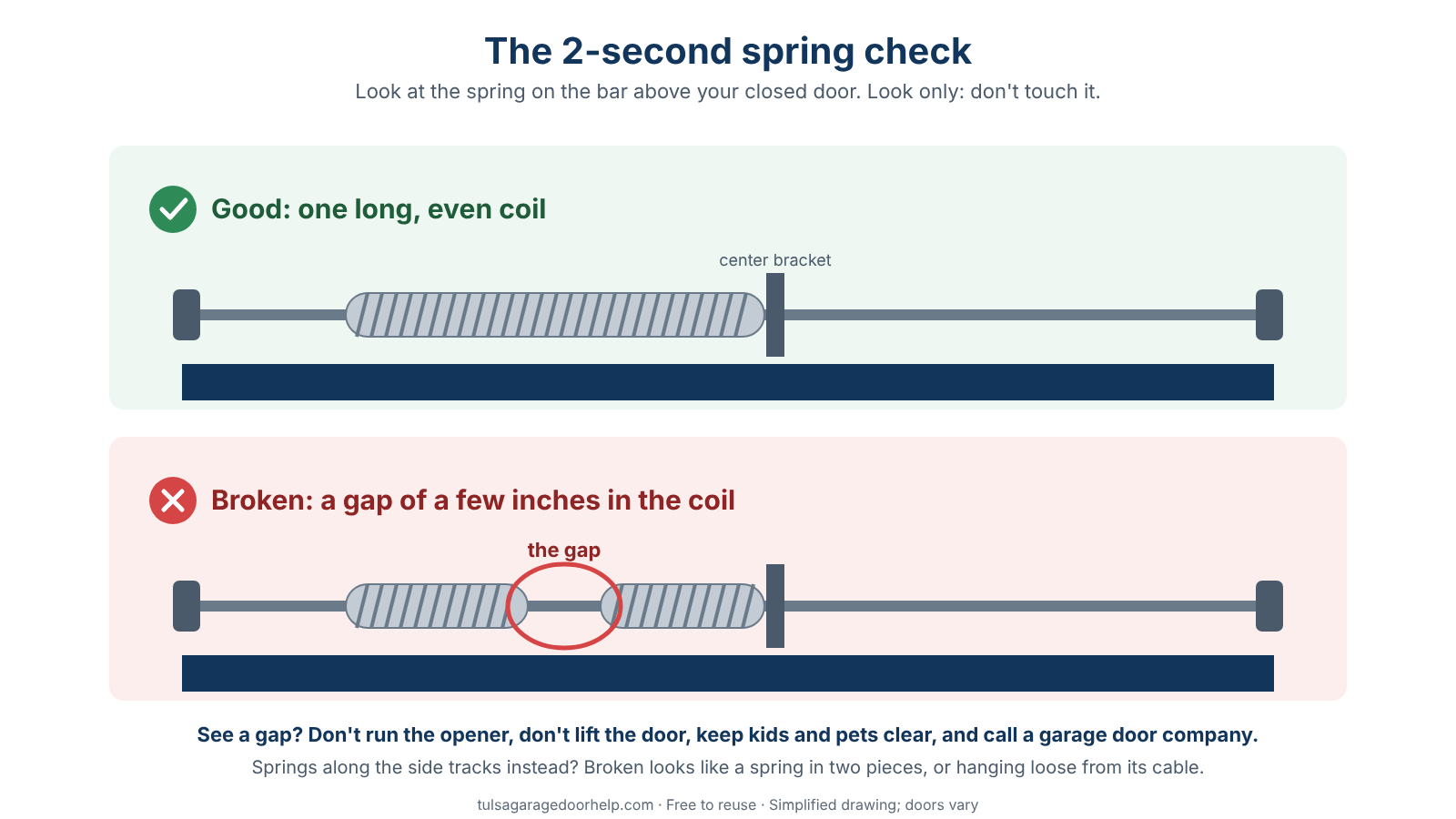
Most likely: Broken torsion spring (the coil above the door)
Clopay lists a loud bang among its broken-spring signs, and calls torsion springs the most common type.
This one needs a garage door company.
Also possible
- Broken extension spring (the long spring beside the upper track). Look along the horizontal tracks: a broken side spring hangs loose, looks stretched or has uneven spacing. Needs a pro
- Opener cannot lift the dead weight, so it only hums or clicks. Opener hums for a moment and the door does not move. Needs a pro
Safe to do now
- Leave the door closed and stop pressing the remote or wall button.
- Look at the springs from the floor, without touching them, to see which kind broke.
- Unplug the opener so nobody runs it by accident.
- Call a trained door technician and say whether it is a spring above the door or beside the track.
Don't
- Do not pull the red release cord or try to lift the door by hand.
- Do not touch, loosen or try to replace the spring, cables or bottom brackets.
- Do not keep running the opener to force the door up.
Battery backup? An opener with a backup battery can still run the door when it is unplugged. Keep everyone clear of the door and keep the remotes out of reach. Your opener's manual says how to disconnect the battery.
Typical price
If it's the most likely cause: Torsion spring replacement: typically $350–$540 (installed). Source: This Old House, updated Mar 10, 2026.
If it turns out to be one of the others:
- Extension spring replacement: typically $300–$400 (installed). Source: This Old House, updated Mar 10, 2026.
National figures, not a quote. Every price range and its source.
Step by step: Broken garage door spring, door won't open: what to do
Photos that help
These three photos help a shop quote it in writing:
- The spring: the bar above the door, or the long springs beside the upper tracks, end to end
- Both bottom corners of the door, where the cables attach
- The whole door from inside the garage
Take them from where you stand. Don't go under the door, and don't touch the springs, cables or tracks. How to send them.
Where this comes from (4 sources)
- Awww, Snap! Do I Have a Broken Garage Door Spring?, Clopay
- What to Do When Your Garage Door Makes Noises, Chamberlain Group (LiftMaster, Chamberlain and Craftsman support)
- TDS 167: Residential Sectional Garage Door & Electric Operator Checklist for Home Inspectors and Consumers, DASMA (Door & Access Systems Manufacturers Association)
- Understanding Garage Door Springs: Types, Functions and Maintenance Tips, Clopay
We read each source on 10 November 2026. The order of causes follows the makers' own troubleshooting pages where they give one; otherwise it is our judgment, and the page says so.
Not quite it? Describe your problem
Describe it in your own words, like "goes back up" or "remote stopped working".
Related problems
- I can see a gap in the big spring above the garage door
- The garage door feels very heavy when I lift it by hand
- The door opens, but will not stay up and comes back down
- The door shoots up fast or flies open on its own
- A long spring beside the track looks stretched out or is hanging down
- A cable at the side of the door is hanging loose, frayed, or off its drum
Got a quote that feels high?
Text the amount and what it covers to (918) 205-5200. We compare it with published price data (the sources on our price page), and text you back within a business day. Free, no obligation, and we don't repair doors.
Diagram: The 2-second spring check: good vs broken torsion spring
See it in 3D
Our 3D garage door model acts this out, with what to do and what not to touch.