
A long spring beside the track looks stretched out or is hanging down
The likely cause, a quick check, what's safe to do, and what it usually costs.
Most likely: Extension spring has broken
Clopay describes a broken extension spring as stretched when the door is closed or unevenly spaced.
This one needs a garage door company.
Also possible
- Extension spring is worn out and has lost its pull. Both springs are intact but one has visible gaps between coils with the door closed. Needs a pro
- Pulley or cable on that side has failed, letting the spring go slack. Spring is whole but the cable beside it is loose, or a pulley is tilted or cracked. Needs a pro
Safe to do now
- Leave the door closed and keep away from the spring's line of travel. If it is open, keep people and cars out from under it.
- Unplug the opener so nobody runs the door by accident.
- Check from a distance whether a safety cable runs through the middle of each side spring.
- Call a trained door technician; expect both side springs to be replaced together.
Don't
- Do not operate the door with a broken or hanging spring.
- Do not unhook, re-hook or stretch the spring back into place.
- Do not pull the red release cord.
Battery backup? An opener with a backup battery can still run the door when it is unplugged. Keep everyone clear of the door and keep the remotes out of reach. Your opener's manual says how to disconnect the battery.
Typical price
If it's the most likely cause: Extension spring replacement: typically $300–$400 (installed). Source: This Old House, updated Mar 10, 2026.
If it turns out to be one of the others:
- Most repairs: typically $98–$371 (across all repairs, including big ones: $98–$860). Source: This Old House, updated May 29, 2026.
National figures, not a quote. Every price range and its source.
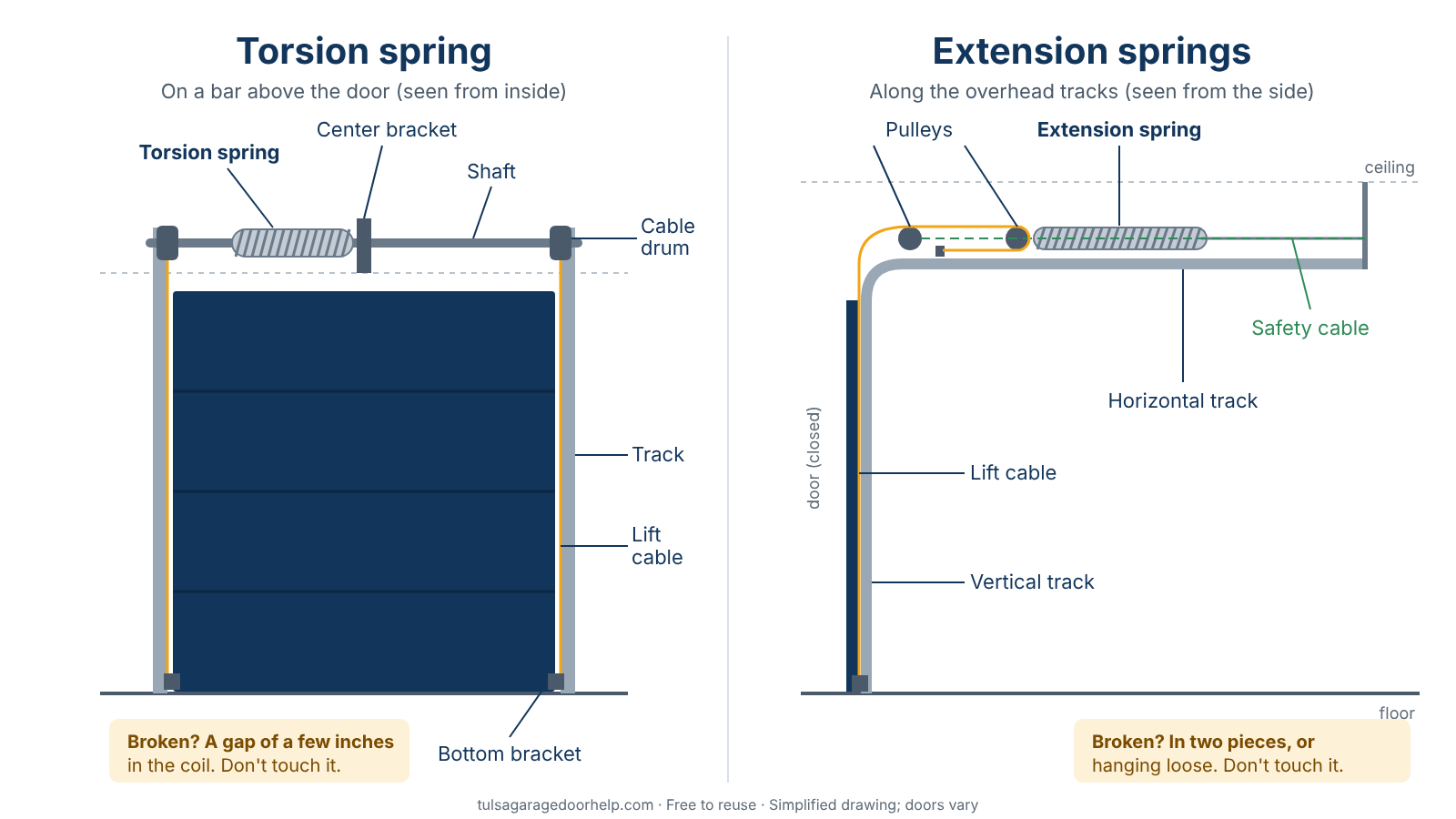
Step by step: Torsion vs extension springs: how to tell them apart
Photos that help
These three photos help a shop quote it in writing:
- The spring: the bar above the door, or the long springs beside the upper tracks, end to end
- Both bottom corners of the door, where the cables attach
- The whole door from inside the garage
Take them from where you stand. Don't go under the door, and don't touch the springs, cables or tracks. How to send them.
Where this comes from (4 sources)
- Awww, Snap! Do I Have a Broken Garage Door Spring?, Clopay
- Safety Tips, DASMA (Door & Access Systems Manufacturers Association)
- Maintaining Your Garage Door, Genie
- Garage Door Troubleshooting Guide: Causes & Solutions, DDM Garage Doors (parts retailer) (trade or home site, used as a second source)
We read each source on 10 November 2026. The order of causes follows the makers' own troubleshooting pages where they give one; otherwise it is our judgment, and the page says so.
Not quite it? Describe your problem
Describe it in your own words, like "goes back up" or "remote stopped working".
Related problems
- A cable at the side of the door is hanging loose, frayed, or off its drum
- The door is crooked, with one side higher than the other
- The opener only gets the door up if I help lift it
- The bar above the door has slid sideways or its center bracket is loose
- The door is heavy or will not lift, and there is only a plain tube above it, no spring
- A side spring or side arm on my one-piece tilt-up door is broken, hanging or loose
Got a quote that feels high?
Text the amount and what it covers to (918) 205-5200. We compare it with published price data (the sources on our price page), and text you back within a business day. Free, no obligation, and we don't repair doors.
Diagram: Garage door springs: torsion vs extension
See it in 3D
Our 3D garage door model acts this out, with what to do and what not to touch.