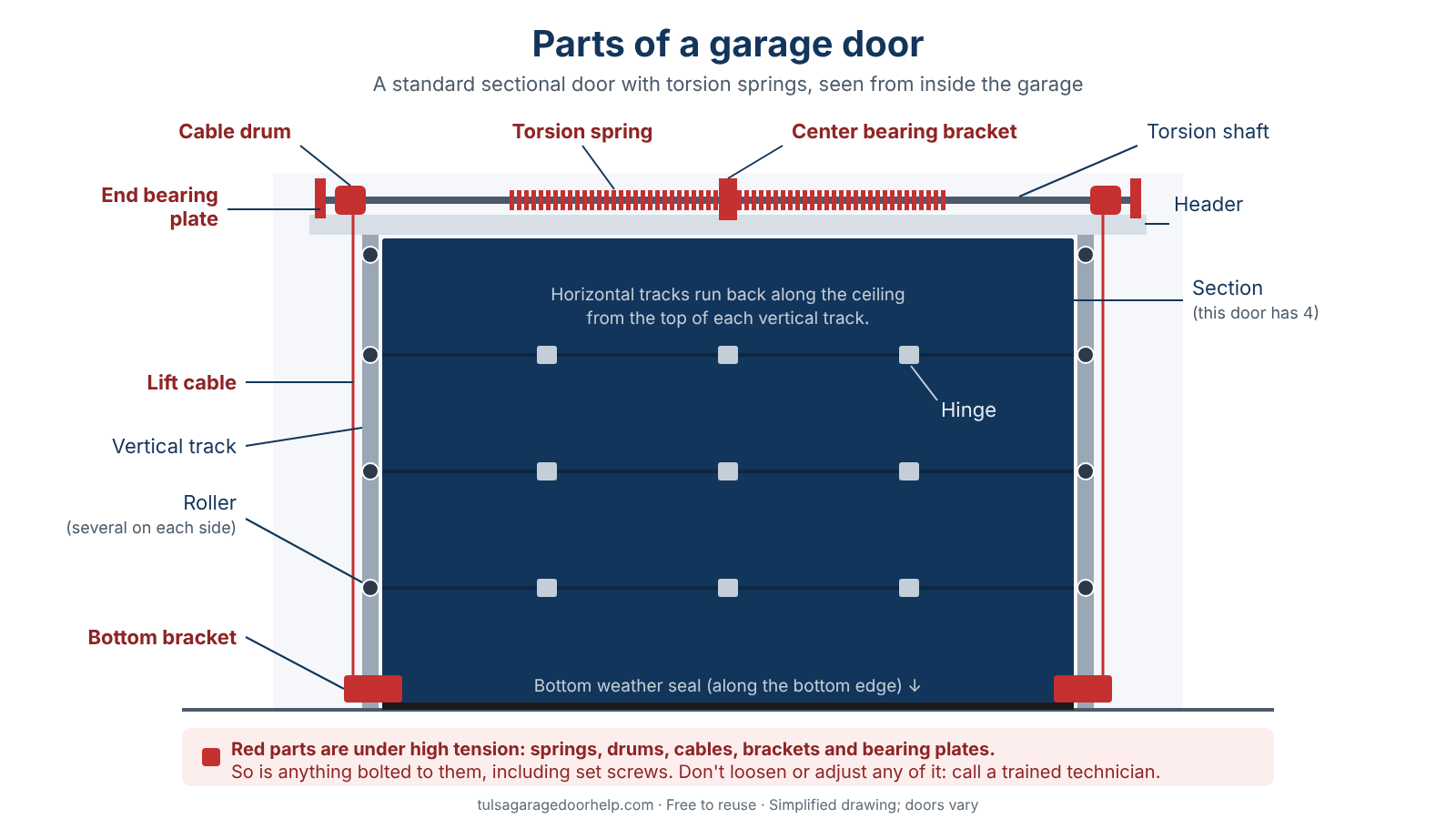
The bar above the door has slid sideways or its center bracket is loose
The likely cause, a quick check, what's safe to do, and what it usually costs.
Most likely: The center bracket is loose or the wood behind it has split
Clopay says the spring anchor brackets hold the springs to the wall; DASMA warns a split pad can let the mount spin off.
This one needs a garage door company.
Also possible
- A bracket that carries the bar, or the bearing in it, has worn out. The last time the door moved, did the bar wobble or grind? Does it sit off-center in a bracket now? Needs a pro
Safe to do now
- Stop using the door, by hand and with the opener.
- Unplug the opener so nobody runs the door by accident.
- Keep people and cars away from the door and out from under the bar.
- Call a garage door company and tell them the spring bar or its bracket has moved.
Don't
- Don't tighten, loosen or tap anything on the bar, its brackets or the red-painted fasteners.
- Red release cord: only with the door fully closed. Never with a broken spring, loose cable or crooked door.
Battery backup? An opener with a backup battery can still run the door when it is unplugged. Keep everyone clear of the door and keep the remotes out of reach. Your opener's manual says how to disconnect the battery.
Typical price
If it's the most likely cause: Most repairs: typically $98–$371 (across all repairs, including big ones: $98–$860). Source: This Old House, updated May 29, 2026.
National figures, not a quote. Every price range and its source.
Photos that help
These three photos help a shop quote it in writing:
- The spring: the bar above the door, or the long springs beside the upper tracks, end to end
- Both bottom corners of the door, where the cables attach
- The whole door from inside the garage
Take them from where you stand. Don't go under the door, and don't touch the springs, cables or tracks. How to send them.
Where this comes from (3 sources)
- Clopay installation instructions and owner's maintenance (INST-0130006), Clopay
- TDS-166 Guidelines For Connecting A Drawbar Operator To A Sectional Garage Door, DASMA (Door & Access Systems Manufacturers Association)
- Single Torsion Springs Need Attention, DASMA (Door & Access Systems Manufacturers Association)
We read each source on 10 November 2026. The order of causes follows the makers' own troubleshooting pages where they give one; otherwise it is our judgment, and the page says so.
Not quite it? Describe your problem
Describe it in your own words, like "goes back up" or "remote stopped working".
Related problems
- The door is heavy or will not lift, and there is only a plain tube above it, no spring
- A side spring or side arm on my one-piece tilt-up door is broken, hanging or loose
- After adding insulation, windows or other weight the door is heavy or drops
- Left half open by hand, the door drifts down instead of staying put
- The long side springs have no cable running through the middle
- The door acts worse after a repair visit or new springs
Got a quote that feels high?
Text the amount and what it covers to (918) 205-5200. We compare it with published price data (the sources on our price page), and text you back within a business day. Free, no obligation, and we don't repair doors.
Diagram: Parts of a sectional garage door