
When does Tulsa freeze? First and last freeze dates from 78 winters
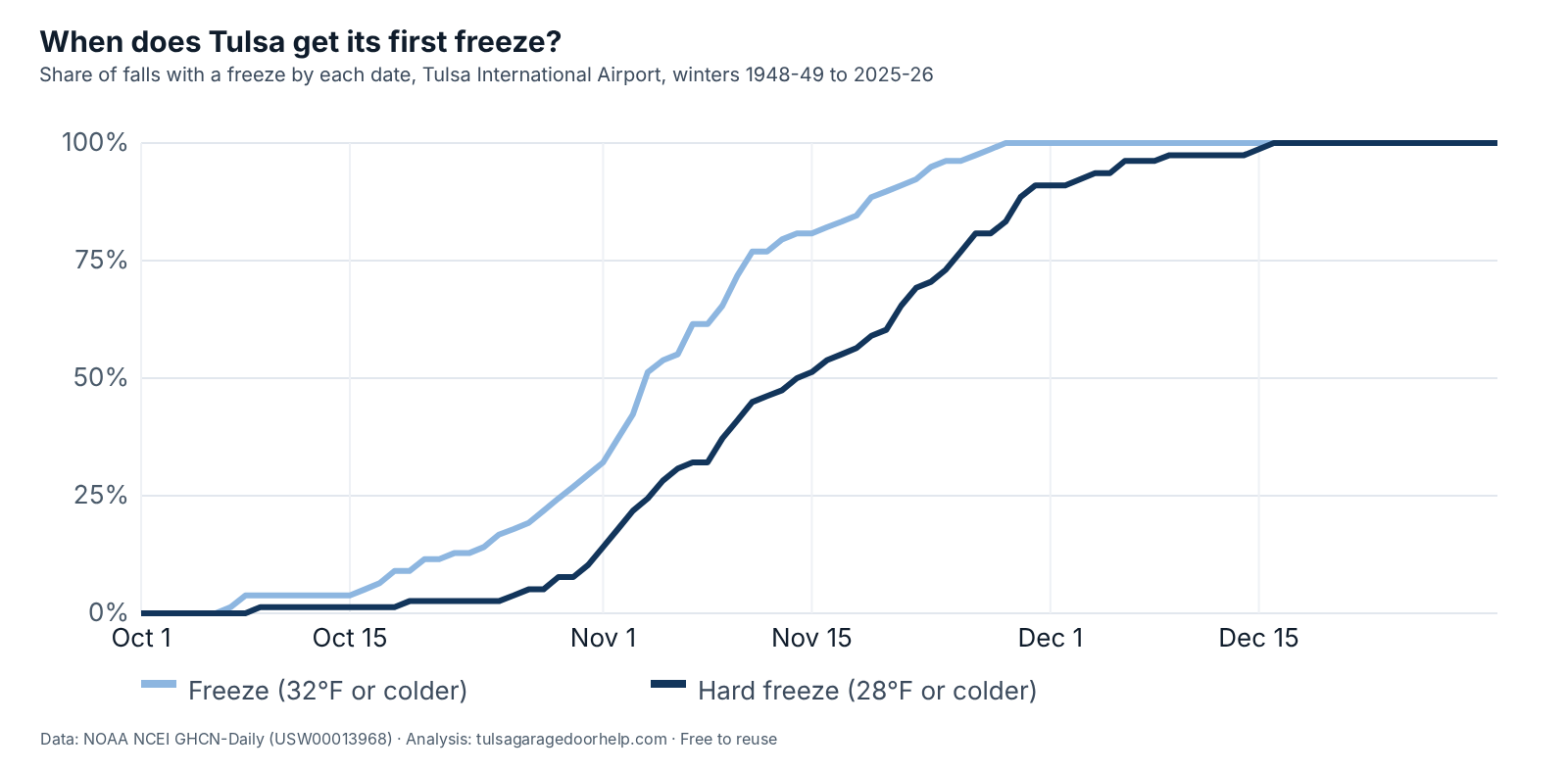
We went through every daily low at Tulsa International Airport from the winter of 1948–49 to 2025–26. In half of those falls the first freeze (32°F, often called the first frost) came by Nov 4 and the first hard freeze (28°F) by Nov 15. In half of springs the last freeze came by Mar 29.
Published November 16, 2026. Data: NOAA NCEI daily records for Tulsa International Airport, winters 1948–49 to 2025–26.
This fall so far (as of November 16, 2026): Tulsa's first freeze came on November 14, 2026, when the airport fell to 30°F (National Weather Service Tulsa: daily climate report for Tulsa (CLI)), and there had been no hard freeze (28°F or colder) yet as of November 16, 2026. In 62 of the 78 winters, the first freeze came earlier than this year's. Our Spring Snap Index rates each day's cold-snap risk for garage door springs, and its free calendar flags every forecast hard-freeze night.
The main findings
| Early year (1 in 10) | Middle | Late year (1 in 10) | |
|---|---|---|---|
| First fall freeze | Early year: by Oct 20 | Middle: Nov 4 | Late year: after Nov 20 |
| Last spring freeze | Early year: by Mar 16 | Middle: Mar 29 | Late year: after Apr 14 |
- Below zero (colder than 0°F) in 20 of 78 winters, about 1 in 4. The coldest low in the record we used was -13°F on February 16, 2021.
- Fewer hard-freeze nights than a few decades ago: about 57 a winter on average in 1951–1980 against about 47 in 1991–2020, and nights of 20°F or colder fell from about 24 to about 16. In this record, the middle date of the first freeze stayed about the same (around Nov 4), while the middle date of the first hard freeze came later (Nov 11 in 1951–1980, Nov 19 in 1991–2020). Freeze dates swing a lot from year to year, so read that as a comparison of two periods, not a forecast.
- Cross-checked: our earliest and latest first-freeze and first-hard-freeze dates, and the earliest last hard freeze, match the National Weather Service's Tulsa freeze statistics, and our 1991–2020 averages come within a fraction of a night of NOAA's official climate normals for the airport (71.7 nights of 32°F or colder a year against NOAA's 71.9; 16.4 of 20°F or colder against 16.2) (National Weather Service Tulsa: Tulsa freeze statistics, 1906 to May 2026 (updated June 4, 2026); NOAA NCEI, U.S. Climate Normals 1991-2020: Tulsa International Airport, annual and seasonal).
"Freeze" here means a daily low of 32°F or colder at Tulsa International Airport; "hard freeze" means 28°F or colder, the line the National Weather Service uses in its Tulsa freeze statistics (National Weather Service Tulsa: Tulsa freeze statistics, 1906 to May 2026 (updated June 4, 2026)). Frost can form on a clear, calm night even when the official low stays a little above 32°F, and your own yard can run colder or warmer than the airport (our note).
Download every winter (CSV). Download the chart (PNG). Free to reuse, share and adapt, with no conditions; please credit us.
Use this image on your site
Free to reuse; please credit us. Copy this HTML; it shows the image and links back to the source page:
<a href="https://tulsagaragedoorhelp.com/tulsa-freeze/"><img src="https://tulsagaragedoorhelp.com/img/tulsa-first-freeze-chart.png" alt="Chart: share of falls with a freeze by each date in Tulsa, winters 1948-49 to 2025-26" width="900" style="max-width:100%;height:auto"></a>
<p>Data: NOAA NCEI GHCN-Daily, Tulsa International Airport, winters 1948-49 to 2025-26, analysis by <a href="https://tulsagaragedoorhelp.com/tulsa-freeze/">Tulsa Garage Door Help</a></p>
Cite this: tulsagaragedoorhelp.com, "When does Tulsa freeze? First and last freeze dates from 78 winters," November 16, 2026, analysis of NOAA NCEI GHCN-Daily records for Tulsa International Airport, https://tulsagaragedoorhelp.com/tulsa-freeze/
The odds of a fall freeze by each date
| By | Freeze (32°F) | Hard freeze (28°F) |
|---|---|---|
| Oct 20 | Freeze by then: 12% | Hard freeze by then: 3% |
| Nov 1 | Freeze by then: 32% | Hard freeze by then: 14% |
| Nov 10 | Freeze by then: 72% | Hard freeze by then: 41% |
| Nov 15 | Freeze by then: 81% | Hard freeze by then: 51% |
| Nov 20 | Freeze by then: 90% | Hard freeze by then: 60% |
| Dec 1 | Freeze by then: 100% | Hard freeze by then: 91% |
| Dec 15 | Freeze by then: 100% | Hard freeze by then: 99% |
The odds of a spring freeze after each date
For gardens and anything left outside: the share of springs that still had a freeze on or after each date.
| On or after | Freeze (32°F) | Hard freeze (28°F) |
|---|---|---|
| Mar 1 | Freeze on or after: 100% | Hard freeze on or after: 81% |
| Mar 15 | Freeze on or after: 92% | Hard freeze on or after: 54% |
| Mar 25 | Freeze on or after: 65% | Hard freeze on or after: 24% |
| Apr 1 | Freeze on or after: 42% | Hard freeze on or after: 14% |
| Apr 10 | Freeze on or after: 18% | Hard freeze on or after: 4% |
| Apr 15 | Freeze on or after: 9% | Hard freeze on or after: 1% |
| Apr 20 | Freeze on or after: 5% | Hard freeze on or after: 0% |
The latest spring freeze in these 78 winters was Apr 24, 2013. The National Weather Service's longer Tulsa record, back to 1906, has a later one (National Weather Service Tulsa: Tulsa freeze statistics, 1906 to May 2026 (updated June 4, 2026)).
When the hardest cold comes
| Date | Low |
|---|---|
| February 16, 2021 | Low: -13°F |
| February 10, 2011 | Low: -12°F |
| February 4, 1996 | Low: -11°F |
| December 23, 1989 | Low: -8°F |
| February 1, 1979 | Low: -7°F |
| February 15, 2021 | Low: -7°F |
| January 30, 1949 | Low: -6°F |
| January 11, 1977 | Low: -6°F |
| December 22, 1989 | Low: -6°F |
| February 3, 2011 | Low: -6°F |
What it means for your garage door
- Cold mornings are a common time for worn springs to fail, by one Oklahoma door company's account: it describes its broken-spring calls roughly doubling after a cold front (Affordable Door Co. (Oklahoma): why springs break in winter). That's one company's experience, not a study. Our Spring Snap Index scores each day from the low and how fast the temperature falls; it's our own rule of thumb, not yet checked against repair records. Run back over these 78 winters, it would have rated about 24 days a winter HIGH, most of them in December to February.
- On a freezing morning, listen for a loud bang from the garage. If the door won't open, don't use the opener, don't pull the red release cord, and leave the door where it is: see is a broken spring an emergency?
- Door frozen to the floor? Don't force it with the opener: how to free a garage door frozen shut. Other cold-weather trouble: garage door problems in cold weather.
| Month | HIGH days per winter |
|---|---|
| October | HIGH days per winter: 0.2 |
| November | HIGH days per winter: 2.5 |
| December | HIGH days per winter: 5.5 |
| January | HIGH days per winter: 7.9 |
| February | HIGH days per winter: 5.3 |
| March | HIGH days per winter: 2.3 |
| April | HIGH days per winter: 0.3 |
Approximate: the index reads a 36-hour forecast; for past winters we used each day's recorded low and the drop from the previous day's high.
The last 10 winters
| Winter | First freeze | First hard freeze | Last hard freeze | Hard-freeze nights | Coldest |
|---|---|---|---|---|---|
| 2025-26 | First freeze: Nov 2 | First hard freeze: Nov 9 | Last hard freeze: Mar 17 | Hard-freeze nights: 39 | Coldest: 0°F |
| 2024-25 | First freeze: Nov 22 | First hard freeze: Nov 26 | Last hard freeze: Feb 23 | Hard-freeze nights: 45 | Coldest: 1°F |
| 2023-24 | First freeze: Oct 30 | First hard freeze: Oct 31 | Last hard freeze: Feb 29 | Hard-freeze nights: 34 | Coldest: -3°F |
| 2022-23 | First freeze: Oct 18 | First hard freeze: Oct 19 | Last hard freeze: Mar 19 | Hard-freeze nights: 44 | Coldest: 0°F |
| 2021-22 | First freeze: Nov 13 | First hard freeze: Nov 19 | Last hard freeze: Mar 12 | Hard-freeze nights: 47 | Coldest: 7°F |
| 2020-21 | First freeze: Nov 23 | First hard freeze: Nov 30 | Last hard freeze: Feb 22 | Hard-freeze nights: 40 | Coldest: -13°F |
| 2019-20 | First freeze: Oct 30 | First hard freeze: Oct 31 | Last hard freeze: Feb 27 | Hard-freeze nights: 35 | Coldest: 15°F |
| 2018-19 | First freeze: Nov 9 | First hard freeze: Nov 9 | Last hard freeze: Mar 16 | Hard-freeze nights: 53 | Coldest: 9°F |
| 2017-18 | First freeze: Oct 28 | First hard freeze: Nov 22 | Last hard freeze: Apr 16 | Hard-freeze nights: 53 | Coldest: 3°F |
| 2016-17 | First freeze: Nov 19 | First hard freeze: Nov 26 | Last hard freeze: Mar 14 | Hard-freeze nights: 35 | Coldest: 3°F |
Every winter since 1948–49 is in the CSV download above.
Quick answers
When is the last frost date in Tulsa? At the airport, the last freeze of spring (32°F) came by Mar 29 in half of the 78 springs, and by Apr 14 in 9 of 10. A freeze on or after April 15 happened in 9% of springs.
When is the first frost in Tulsa? The first fall freeze came by Nov 4 in half of the falls, and by Nov 20 in 9 of 10. In 1 fall in 10 it came by Oct 20.
When is Tulsa's first hard freeze? Half of falls had one (28°F or colder) by Nov 15, and 91% by Dec 1.
How we counted
- Data: NOAA's Global Historical Climatology Network daily file for Tulsa International Airport, station USW00013968 (NOAA NCEI, Global Historical Climatology Network - Daily: Tulsa International Airport (USW00013968), daily temperatures), downloaded November 16, 2026; its latest day was November 10, 2026. This fall's dates after that come from the National Weather Service's daily climate reports for Tulsa (National Weather Service Tulsa: daily climate report for Tulsa (CLI)).
- Winters run from July 1 to June 30, from 1948–49 to 2025–26 (78 winters). We started in 1948 because the airport file has gaps in the mid-1940s. No winter was missing more than 1 daily low between October and April.
- Temperatures: the file stores tenths of a degree Celsius; we converted them back to whole degrees Fahrenheit, the way the station reports them. The file has 11 values NOAA flags as failing a quality check (2 of them in the years we used); we dropped them.
- Dates are counted on the calendar, so a leap year doesn't shift them. "1 in 10" dates are the 10th and 90th percentiles.
- Periods: "1951–1980" and "1991–2020" mean the 30 winters ending in those years (1950–51 to 1979–80, and 1990–91 to 2019–20), close to NOAA's standard 30-year normal periods, which use calendar years.
- The National Weather Service's own odds: NWS Tulsa publishes first-freeze odds by date for Tulsa: 1 in 10 by October 25, half by November 6 and 9 in 10 by November 19 (National Weather Service Tulsa: probability of first freeze by date, Tulsa (read Nov 16, 2026)). The page doesn't say which years it covers; ours are from 1948–2026, which is likely why they differ by a few days.
- Middle dates are medians: half of the winters were earlier, half later. The National Weather Service publishes average (mean) dates over its longer record from 1906, which come out within a day of ours (National Weather Service Tulsa: Tulsa freeze statistics, 1906 to May 2026 (updated June 4, 2026)).
- Limits: this is one weather station, at the airport. Your own yard can run colder or warmer on a given night, and the record says nothing about any one neighborhood.
How it was made: we ran this analysis with the help of an AI assistant (Claude), from NOAA's public file. On November 16, 2026, a separate AI reviewer recomputed every figure from the raw file; we fixed the spring odds it caught (a leap-day counting error) before publishing. The analysis script is available on request.
Analysis by tulsagaragedoorhelp.com, a garage door guide and price site that plans to refer Tulsa-area homeowners to one local repair company. We're not affiliated with NOAA or the National Weather Service. Questions or corrections: hello@tulsagaragedoorhelp.com.
Ice storms: NWS Tulsa logged 9 ice storms for Tulsa County in 30 winters, all between late November and late January (NOAA NCEI Storm Events Database: bulk data files, 1996-2026 (Oklahoma, zone OKZ060, Tulsa; NWS Tulsa), our count). See Tulsa ice storms and snow.