Is today a risky day for springs? Our Spring Snap Index rates the risk for Tulsa twice a day, from the overnight low and how fast the temperature drops. It's our own rating, not a guarantee.
First: when to stop
Clopay says springs get more brittle and weaker in the cold, and that a broken spring shows as a pop or a gap in the coil (Clopay: fixing garage door problems from cold weather (Jan 2024)). Clopay also says spring repair is a job for a professional. If you heard a bang, see a gap in a spring, a loose cable, or the door hangs crooked, don't run the door, even to close it. See broken garage door spring: what to do now.
What's normal in the cold
Genie says cold weather can make metal parts contract, which can lead to squeaky hinges or a sluggish door (Genie: before winter hits, check out these maintenance tips (updated Nov 8, 2024)). Clopay says cold can make lubricant harden and get gunky (Clopay: fixing garage door problems from cold weather (Jan 2024)). So a door that is a little slower and noisier on a frosty morning isn't, on its own, a sign of a fault. A door that struggles, stops or reverses is different: see below.
Each cold-weather problem, and what to do
The door won't close, or goes back up, only when it's cold
A Chamberlain owner's manual says to clear any ice or snow from the floor where the door closes. It also says weather in particular can affect how far the door travels, that the limits may need an occasional adjustment, and that you should repeat the safety reverse test after any adjustment (Chamberlain 8200 1/2 HP owner's manual, page 35, Having a problem? (manualsdir.com copy)). Frost or road spray on the safety sensor lenses can also make a door go back up, so wipe them with a soft cloth (our advice; see sensors guide). Never turn up the force setting to make it close. The door reverses only when it's cold · reset the travel limits.
The door is frozen to the ground
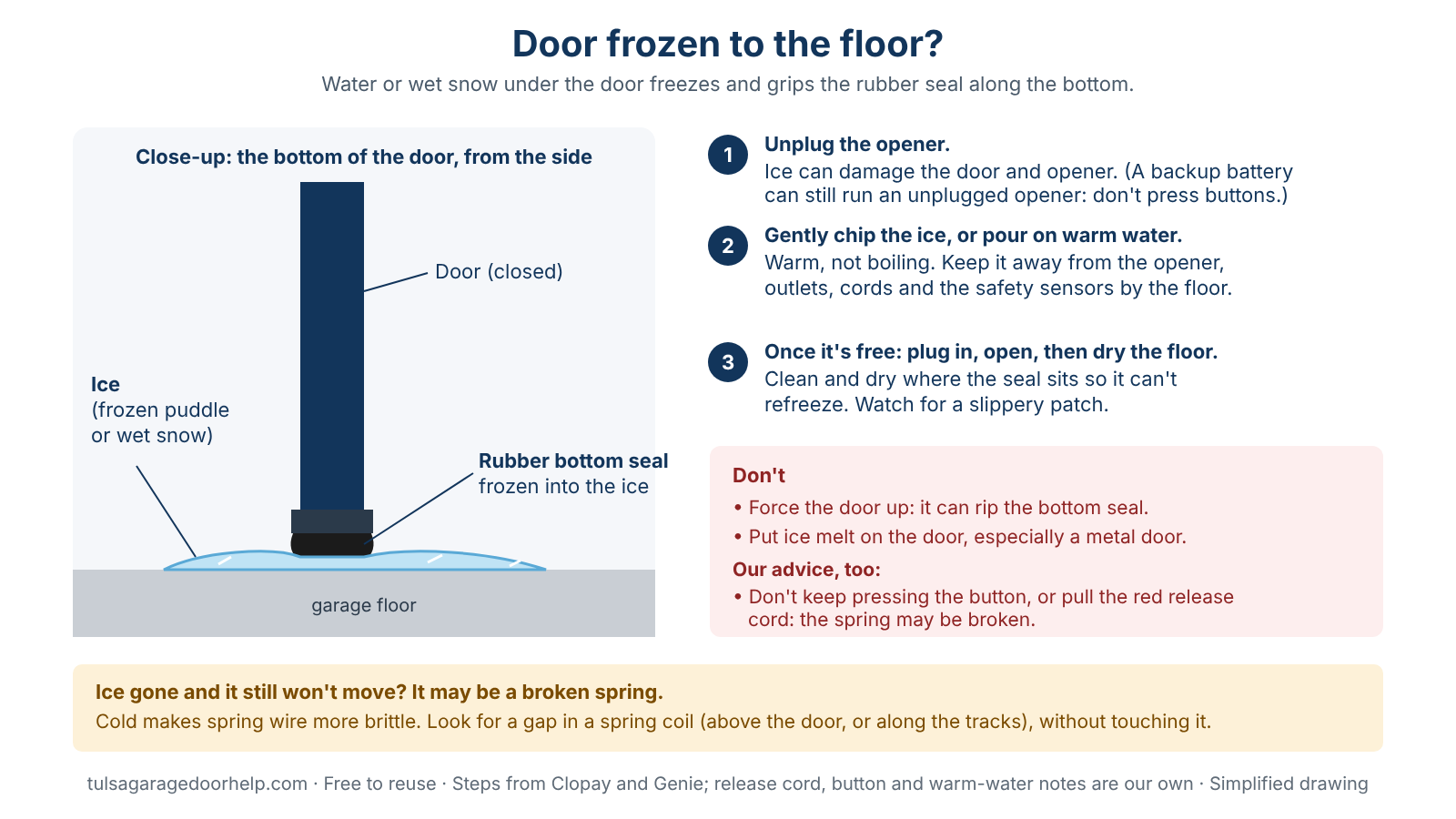
Clopay's advice: gently chip the ice away or melt it with warm water, then clean and dry the area. Don't force the door, which can tear the seal, and don't use ice melt on the door, especially a metal one (Clopay: fixing garage door problems from cold weather (Jan 2024)). Stop pressing the button as soon as the door won't move, and unplug the opener until the door is free so nobody else tries it (our advice). Garage door frozen shut? How to free it safely.
Slow, noisy, or the opener strains
Genie suggests a light silicone grease on moving parts, and, for its screw-drive openers in winter, Genie's own cold-weather lubricant (Genie: before winter hits, check out these maintenance tips (updated Nov 8, 2024)). Clopay says not to use WD-40, which can cause problems in the cold, and not to lubricate nylon rollers (Clopay: fixing garage door problems from cold weather (Jan 2024)). If the opener strains even after that, the springs may be the problem, not the cold. Don't pull the release cord to test the door by hand unless the door is fully closed and the springs and cables look whole; a technician can check the balance safely. How to lubricate a garage door · screw-drive opener slow in the cold · door opens slower than it used to.
The remote or keypad stops working
Genie says cold weather can drain remote and keypad batteries faster, and suggests replacing them before they die (Genie: before winter hits, check out these maintenance tips (updated Nov 8, 2024)). Remote or keypad not working?
Frost, condensation or mold on the inside of the door
DASMA, the door makers' trade group, says condensation is typical of a warm, humid garage and a colder door, that it is not normally a product defect, and that good garage ventilation controls the humidity (DASMA Technical Data Sheet #195: condensation on sectional garage doors). A wet or snowy car brings in a lot of that moisture. Wet, frosty or moldy door.
The garage is freezing
Clopay says that with a non-insulated door the garage becomes hot in summer and cold in winter (Clopay: insulated vs non-insulated garage doors). Check the seals along the bottom, sides and top first. Don't add insulation panels to a door without having the springs checked, because they add weight. Garage too cold or too hot.
Ice storm or power outage
Chamberlain says an opener with a backup battery beeps every 2 seconds while it runs on that battery (Chamberlain Group support: why is the garage door opener beeping?). Only pull the red release cord with the door fully closed, and never with a broken spring, a loose cable or a crooked door. The CPSC says never use a portable generator in a garage, and to run it outside and far from your home (CPSC: generators and engine-driven tools (carbon monoxide safety guide)). An open garage door doesn't make it safe, and the same goes for warming up a car in the garage: back it out first, and keep a working carbon monoxide alarm in the house (our advice). Our guide to opening the door without power also covers reconnecting the opener when the power comes back. Open the door without power · battery backup and beeping · opener not working after a power outage.
Before the first hard freeze: a 10-minute check
- Look at the springs above the door from the floor. A gap in a coil means stop and call a technician
- Clear the floor line where the door closes. Genie says ice and snow that build up under the door can freeze it to the ground (Genie: before winter hits, check out these maintenance tips (updated Nov 8, 2024))
- With the door closed and the opener unplugged, lubricate the parts your door or opener maker names. Plug it back in when you're done
- Change the remote and keypad batteries if they're more than a year old (our advice)
- Test the safety reversal: lay a 2x4 flat under the middle of the door and close it. Chamberlain says the door must touch the board and go back up (Chamberlain Group support: how to test the safety reversal system). If it doesn't, stop using the opener until it's fixed
- If your opener has a backup battery, test it before an ice storm, not during one (when ice storms hit Tulsa)
Not sure what you're looking at? The door checker asks what you see and points to the likely cause.
Getting a repair quote? Compare it with typical prices, with their sources, or put it into the free quote checker.
Sources
- Clopay: fixing garage door problems from cold weather (Jan 2024)
- Genie: before winter hits, check out these maintenance tips (updated Nov 8, 2024)
- Chamberlain 8200 1/2 HP owner's manual, page 35, Having a problem? (manualsdir.com copy)
- DASMA Technical Data Sheet #195: condensation on sectional garage doors
- Clopay: insulated vs non-insulated garage doors
- Chamberlain Group support: why is the garage door opener beeping?
- CPSC: generators and engine-driven tools (carbon monoxide safety guide)
- Chamberlain Group support: how to test the safety reversal system