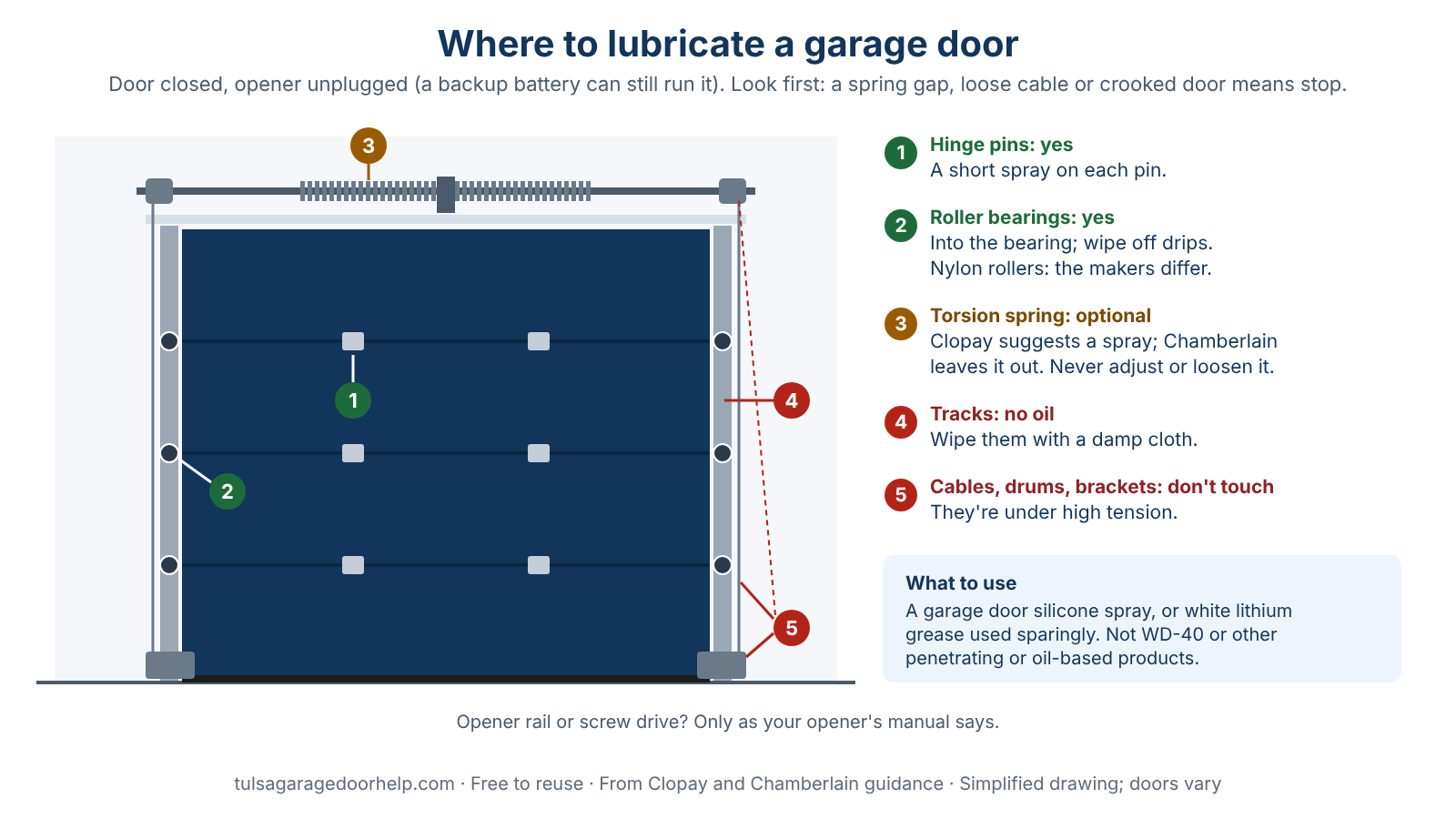
Which lubricant to use
- Silicone spray for hinges and rollers. Clopay, a door maker, also lists white lithium grease, used sparingly because grease attracts dirt (Clopay: how to properly lubricate garage door components (no date shown))
- Chamberlain's maintenance steps just say “garage door lubricant” (Chamberlain Group support: does my garage door opener need monthly or annual maintenance?). A spray sold for garage doors, with a straw nozzle, is the easiest to aim
Not WD-40 or other penetrating oils. Clopay says WD-40 “isn't actually a lubricant” (it's a water displacer) and that penetrating oils can soften plastic, nylon and rubber parts, nylon rollers especially (Clopay blog: why you should never use WD-40 on a garage door (Aug 3, 2022)). Clopay's lubrication guide also says to avoid oil-based lubricants (Clopay: how to properly lubricate garage door components (no date shown)).
We don't recommend brands. A garage door silicone or lithium spray fits Clopay's guide. Some door makers' manuals name other products, so if yours names one, use that.
What to lubricate, and what to leave dry
Step by step
- Look first. A gap in the spring coil, a frayed or loose cable, or a door sitting crooked means stop: don't lubricate or run it, and get a technician. Chamberlain says to stop using a door that looks damaged and to call a professional if it looks out of balance (Chamberlain Group support: does my garage door opener need monthly or annual maintenance?).
- Close the door and unplug the opener, so nobody runs the door while you're working (Chamberlain says to cut its power before greasing the rail: Chamberlain Group support: does my garage door opener need monthly or annual maintenance?). If the opener has a backup battery, disconnect that too as its manual shows, or the door can still move.
- Wipe the tracks with a damp cloth. Don't oil them.
- Spray each hinge pin and each roller bearing (nylon rollers: see the table). Clopay suggests turning the roller shaft to spread it (Clopay care tip: lubricating noisy wheel rollers (Mar 2019)). At the bottom corners, spray the roller only: don't touch the bottom brackets or the cables (Chamberlain Group support: does my garage door opener need monthly or annual maintenance?; DASMA Technical Data Sheet #167 (revised Apr 2023): garage door and opener checklist for home inspectors and consumers).
- Springs (optional). If you do it, spray from the floor with the straw nozzle if you can reach. Otherwise use a step ladder inside the garage, set to one side of the spring rather than right under it, and spray from arm's length. The door must stay closed and the opener unplugged (step 2). Don't touch the spring, its end cones, the cables or the brackets. It's under high tension (Clopay: how to properly lubricate garage door components (no date shown)), and DASMA says not to remove, repair or adjust springs or door parts yourself (DASMA Technical Data Sheet #167 (revised Apr 2023): garage door and opener checklist for home inspectors and consumers). If in doubt, skip it.
- Wipe off the excess. Lubricant shouldn't drip (Clopay: how to properly lubricate garage door components (no date shown)). Our own advice: wipe up any on the floor so nobody slips, and keep spray off an opener's chain unless your manual says to lubricate it. Never lubricate an opener belt: Genie says not to lubricate a belt drive.
- Plug the opener back in and run the door up and down a few times to spread it.
How often?
Chamberlain lists door lubrication as a yearly job (Chamberlain Group support: does my garage door opener need monthly or annual maintenance?). Clopay says every 3–6 months depending on use and climate, nearer 3 months for a door used heavily every day (Clopay: how to properly lubricate garage door components (no date shown)). Putting the two together: at least once a year, and sooner if it squeaks or gets heavy daily use. For the other yearly checks, see how often a garage door should be checked.
Still noisy after that?
Find out whether it's the door or the opener (Chamberlain Group support: how to troubleshoot noise from garage door openers):
- Door on its own. Only if nothing looked broken in step 1. With the door fully closed and the doorway clear, pull the red release cord and lift the door by hand a few inches first; if it's heavy or hard to move, lower it and stop (DASMA Technical Data Sheet #174 (rev. Apr 2017, reaffirmed 2019): checking a residential sectional garage door for damage). Then lift it slowly to about waist height, feet clear. It should move smoothly and feel balanced (Chamberlain Group support: how to troubleshoot noise from garage door openers). If it's heavy or won't stay put, lower it and stop: have a technician check the balance, which usually means the springs (Chamberlain Group support: does my garage door opener need monthly or annual maintenance?).
- Opener on its own. Lower the door fully closed again. Keep it disconnected (on a Chamberlain or LiftMaster T-shaped rail, pull the cord down and then back toward the opener, so it doesn't reconnect: Chamberlain Group support: How to manually open or close a garage door), keep the doorway clear, and run the opener. If the opener alone is noisy, Chamberlain says check the chain or belt tension (your manual shows how), or lubricate a screw drive (Chamberlain Group support: how to troubleshoot noise from garage door openers).
- Reconnect the way your opener's manual shows: how to reconnect each type.
Grinding, a loud bang, or a cable hanging loose: stop using the door (Chamberlain Group support: does my garage door opener need monthly or annual maintenance?). See is a broken spring an emergency? and cable snapped.
Getting a repair quote? Compare it with typical prices, with their sources, or put it into the free quote checker.
Sources
- Clopay: how to properly lubricate garage door components (no date shown)
- Clopay blog: why you should never use WD-40 on a garage door (Aug 3, 2022)
- Clopay care tip: lubricating noisy wheel rollers (Mar 2019)
- Chamberlain Group support: does my garage door opener need monthly or annual maintenance?
- Chamberlain Group support: how to troubleshoot noise from garage door openers
- Chamberlain Group support: How to manually open or close a garage door
- Genie: apply screw drive lubricant to a garage door opener
- DASMA Technical Data Sheet #167 (revised Apr 2023): garage door and opener checklist for home inspectors and consumers
- DASMA Technical Data Sheet #174 (rev. Apr 2017, reaffirmed 2019): checking a residential sectional garage door for damage