The garage door industry's association, DASMA, publishes a checklist "for home inspectors and consumers". Many inspection write-ups cover the same items. If any answer is "no", DASMA says to stop and contact a trained door systems technician (DASMA Technical Data Sheet #167 (revised Apr 2023): garage door and opener checklist for home inspectors and consumers).
Safety items (fix before move-in)
| What the report says | What it means |
|---|---|
| "Door did not reverse on contact" / "failed auto-reverse" | Closing on a 2x4 laid flat under the door, it should reverse and go back up (DASMA Technical Data Sheet #167 (revised Apr 2023): garage door and opener checklist for home inspectors and consumers). If it doesn't, the opener needs adjusting, repairing or replacing. Until then, don't use the opener. Opening it by hand is only safe with the door closed and the springs working: see how to open a garage door by hand. |
| "No photo eyes" / "photo eyes mounted too high" | The beam should be no more than 6 inches above the floor, and breaking it should send a closing door back up (DASMA Technical Data Sheet #167 (revised Apr 2023): garage door and opener checklist for home inspectors and consumers). Openers made on or after Jan 1, 1993 must have protection against trapping someone: photo eyes, a sensor on the door's bottom edge, or a wall button you have to hold down until the door closes (CPSC news release, Dec 3, 1992: final rules for automatic garage door openers made on or after Jan 1, 1993). No eyes and no edge sensor usually means an old opener; DASMA says to check the opener's manual, and to replace an opener that has no such protection (DASMA Technical Data Sheet #167 (revised Apr 2023): garage door and opener checklist for home inspectors and consumers). |
| "Extension springs lack safety cables" | Springs along the side tracks need a containment cable running through the center, so a broken spring can't fly loose (DASMA Technical Data Sheet #167 (revised Apr 2023): garage door and opener checklist for home inspectors and consumers). |
| "Wall button too low / out of sight of the door" | DASMA says at least 5 feet above the floor and in view of the door, away from moving parts (DASMA Technical Data Sheet #167 (revised Apr 2023): garage door and opener checklist for home inspectors and consumers). |
Usually not urgent, but worth a quote
- Missing warning labels: DASMA lists a spring warning label, a general warning label on the door, labels near the bottom brackets and one near the wall button (DASMA Technical Data Sheet #167 (revised Apr 2023): garage door and opener checklist for home inspectors and consumers)
- Manual release handle missing, not red, or more than 6 feet up: DASMA says it should be red and no higher than 6 feet (DASMA Technical Data Sheet #167 (revised Apr 2023): garage door and opener checklist for home inspectors and consumers)
- Door doesn't stay put: DASMA's checklist expects a door disconnected from the opener to stay where it's left, about 3–4 feet up. If it doesn't, have a trained technician check it (DASMA Technical Data Sheet #167 (revised Apr 2023): garage door and opener checklist for home inspectors and consumers). If you try it yourself, do it only with the door fully closed and nothing looking broken, as in our lubrication guide; if it's heavy or drops, stop and leave it to a technician. A door that won't stay put usually means a spring problem, and only a technician should adjust springs
- Cracked or separating panels: not one to leave. DASMA's checklist says to stop and contact a trained technician if the sections are cracked or separating. Stop using the door and unplug the opener until a technician has looked. A backup battery can still run it, so don't press any button
What to ask before closing
- Ask the seller to fix the safety items, or for a credit based on a written quote
- Get the quote itemized, so you can see what's a safety fix and what's an upgrade
- Don't let anyone adjust springs or cables who isn't a trained door technician
Checks you can repeat after you move in
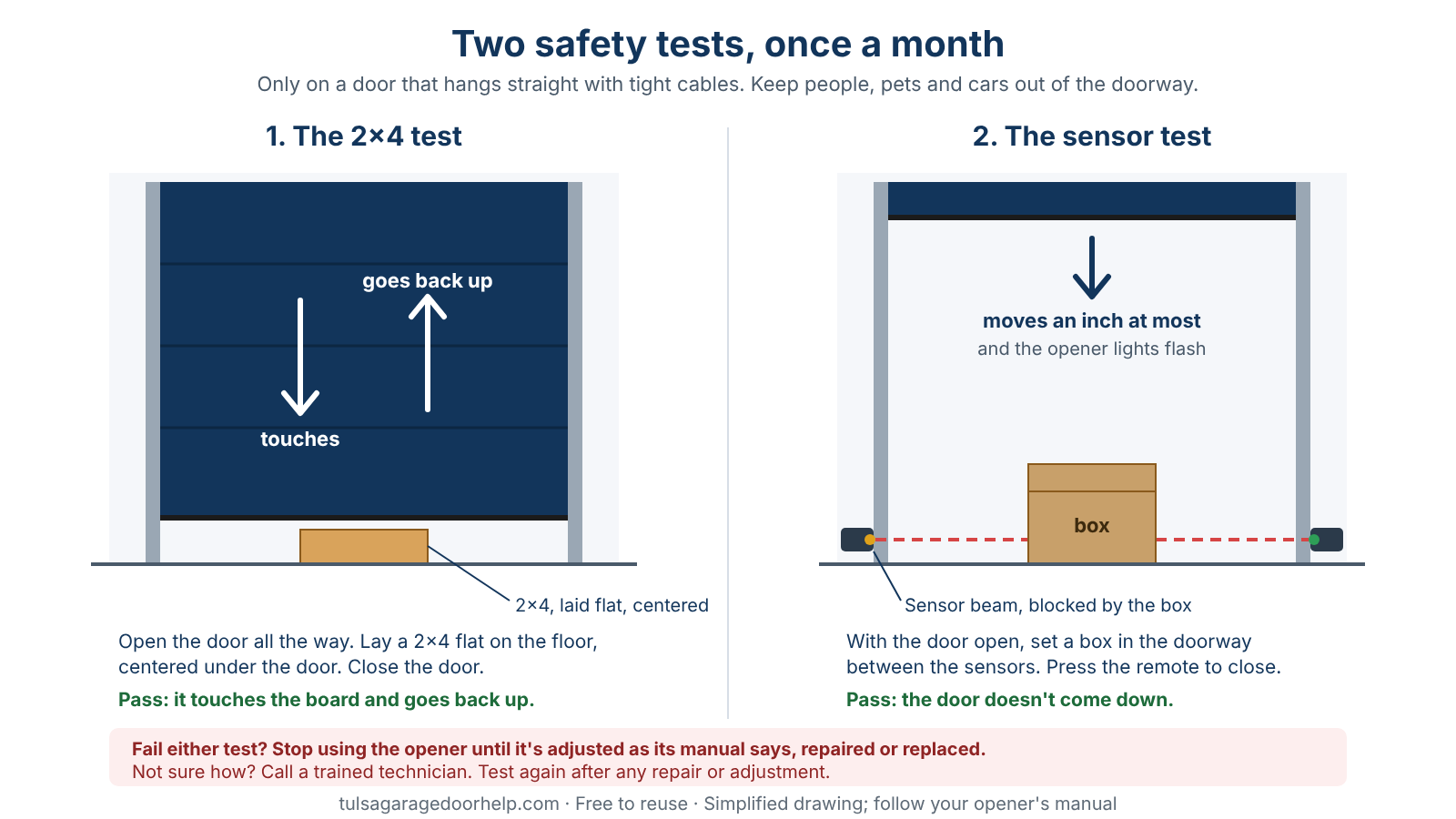
- Monthly 2x4 test: lay a 2x4 flat under the middle of the door and close it. It should touch the board and go back up. LiftMaster says to test this every month (LiftMaster 8550W/8557W user's guide 114A5013, 2017 (FCC copy); DASMA Technical Data Sheet #167 (revised Apr 2023): garage door and opener checklist for home inspectors and consumers)
- Photo eye test: stand to the side, out of the door's path, and while the door is closing wave a broom handle or a box (not your hand or foot) through the beam. The door should go back up (DASMA Technical Data Sheet #167 (revised Apr 2023): garage door and opener checklist for home inspectors and consumers)
- Sunny-day trouble: if the door refuses to close only in low sun, it's likely sensor glare rather than a fault. The sun glare checker shows when it can happen at your garage
Not sure what a quote should cost? See typical prices with sources, or put a written quote into the free quote checker.