First: is it safe to open manually?
The springs do the heavy lifting, not the opener. If a spring is broken, the door's whole weight is on whoever lifts it, and it can fall without warning. Don't try it if (Chamberlain Group support: How to manually open or close a garage door; LiftMaster 8550W/8557W user's guide 114A5013, 2017 (FCC copy); Genie: The power is out: how to open your garage door manually):
- you heard a loud bang, or there's a gap in the spring coil on the bar above the door
- a cable is loose or hanging, or the door is crooked
- the door feels very heavy, won't stay up, or drops when you let go
Any of those: leave it closed and read broken spring, door won't open.
How to open a garage door manually from inside
Door stuck open? Leave it open and don't pull the release cord. LiftMaster says to use the release with the door closed whenever possible, and to take care if it's open: with a weak or broken spring, an open door can fall fast and without warning (LiftMaster 8550W/8557W user's guide 114A5013, 2017 (FCC copy)). Our rule is stricter: never release an open door. Keep people, pets and cars out from under it, and wait for the power to come back or have a technician close it.
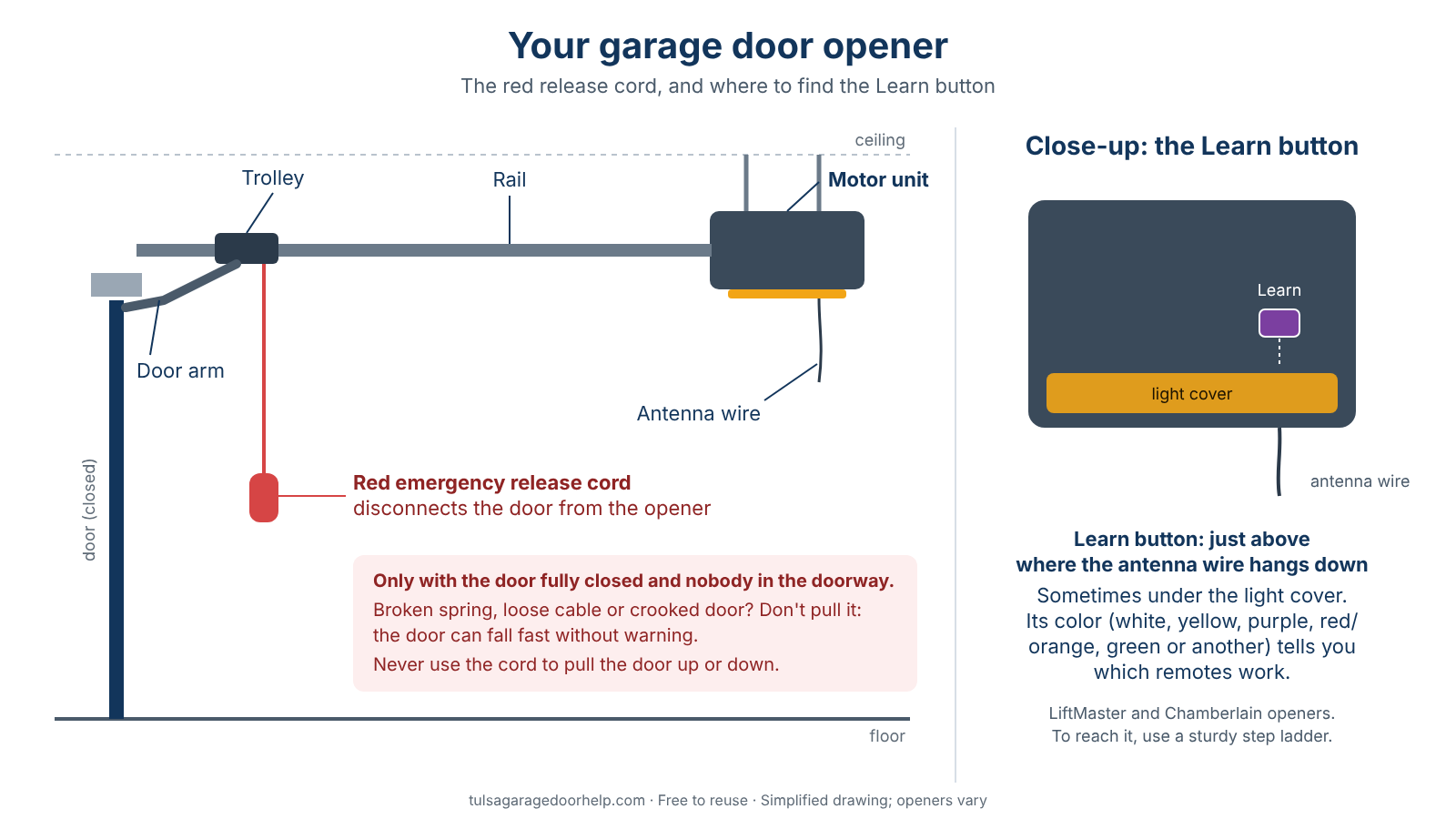
- Only with the door fully closed (if it's open, see above: don't release it). LiftMaster says to use the emergency release with the door closed whenever possible, because with weak or broken springs an open door can fall fast (Chamberlain Group support: How to manually open or close a garage door; LiftMaster 8550W/8557W user's guide 114A5013, 2017 (FCC copy)). Make sure no one and nothing is in the doorway (LiftMaster 8550W/8557W user's guide 114A5013, 2017 (FCC copy)).
- Pull the red cord hanging from the opener rail straight down. That disconnects the door from the opener (Chamberlain Group support: How to manually open or close a garage door).
- Lift it a few inches first, using the bottom handle. If it's heavy or hard to move, lower it and stop (DASMA Technical Data Sheet #174 (rev. Apr 2017, reaffirmed 2019): checking a residential sectional garage door for damage). If it moves easily, lift it slowly to about waist height and let go gently with your feet clear. A door with working springs feels fairly light and stays put. If it starts to drop, lower it and stop. If it's fine, lift it the rest of the way.
- Drive out, then lower it by hand. Make sure you have another way into the house before you leave (Genie: The power is out: how to open your garage door manually). While it's disconnected, the opener isn't holding the door shut, so reconnect it once the power's back (below).
Never use the red cord to pull the door up or down (Chamberlain Group support: How to manually open or close a garage door; LiftMaster 8550W/8557W user's guide 114A5013, 2017 (FCC copy)), and keep fingers away from the joints between the panels.
Locked out, with the power off?
Some garage doors have a small round key lock near the top of the door, outside. Turning the key and pulling the lock out disconnects the opener so the door can be lifted by hand. Chamberlain notes it only disconnects the opener; it doesn't lift the door. Without one (and with no other way in), the door can't be opened from outside during a power outage (Chamberlain Group support: How to manually open or close a garage door).
When the power comes back: reconnect it
It depends on the opener:
- LiftMaster and Chamberlain with a T-shaped rail: pull the red handle straight down, then press the wall button. The opener reconnects on its next up or down run (Chamberlain Group support: How to manually open or close a garage door; LiftMaster 8550W/8557W user's guide 114A5013, 2017 (FCC copy))
- LiftMaster and Chamberlain with a square rail: pull the cord toward the opener, then run the opener through one full open-and-close. If it hasn't reconnected, run it once more (Chamberlain Group support: How to manually open or close a garage door)
- Genie: unplug the opener first, since Genie says to unplug it before working on the motor or carriage. Take out any backup battery too. Then pull the cord up and toward the motor until you hear a click (Genie also says toward the door on some models, so check your manual), or push the release lever up with a broom handle. Plug it back in and run it (Genie: The power is out: how to open your garage door manually)
If the opener won't run at all after an outage, Genie suggests unplugging it for up to 30 seconds and plugging it back in (Genie: The power is out: how to open your garage door manually).
Never want to do this again?
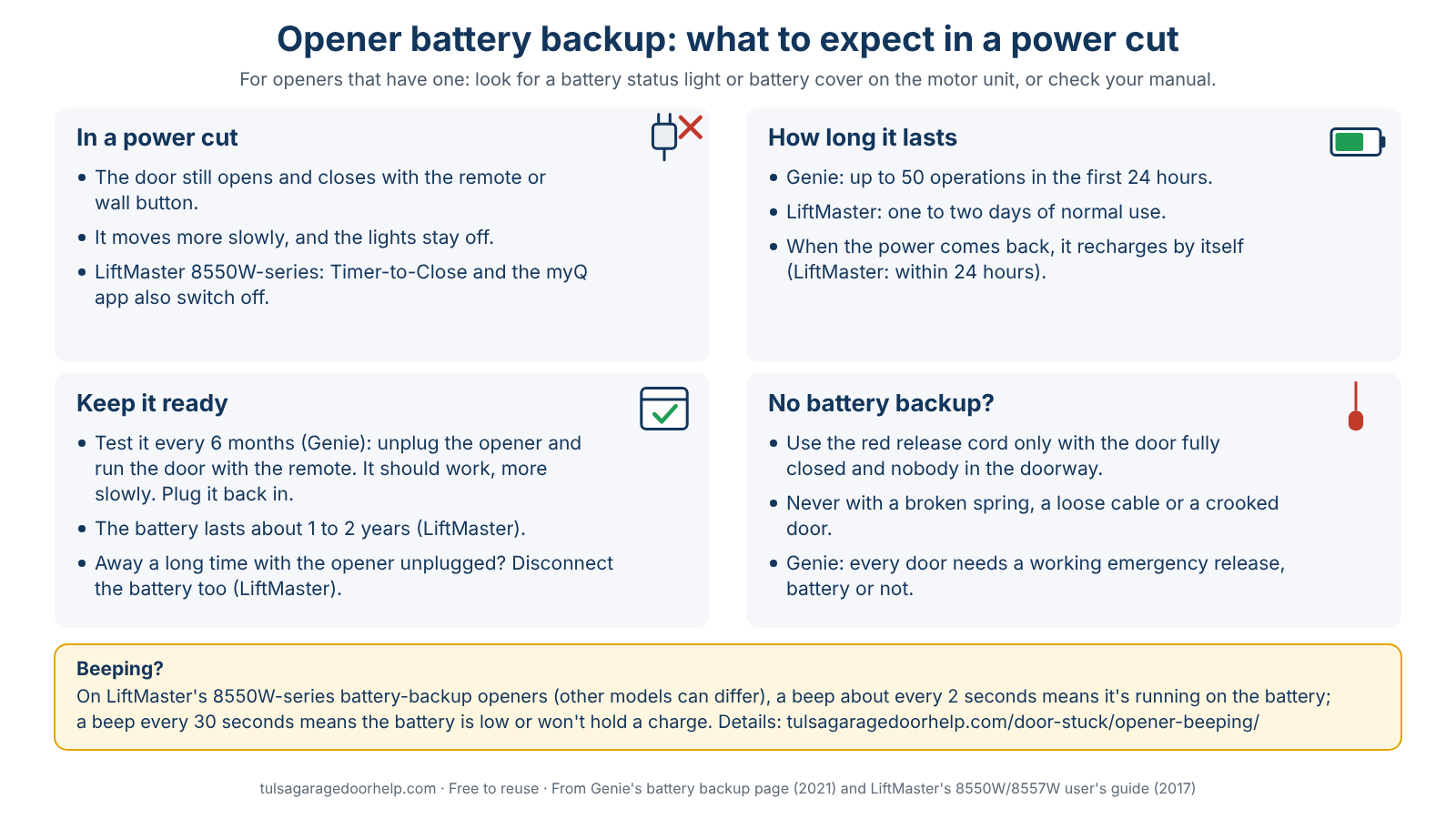
Some openers have a battery backup that keeps the door working in a power outage. Genie says its backups give up to 50 operations in the first 24 hours (Genie: battery backup options (2021)). See opener battery backup: beeping and power outages.
Still stuck?
- The door won't move by hand even with the cord pulled: first check that a slide lock or bolt on the door isn't engaged. If not, something's jammed or a spring may be broken. Leave it closed
- The opener runs but doesn't move the door after the power's back: it may not have reconnected. Reconnect it as above for your rail type or brand, and run it again
- The opener is dead after a storm: check the outlet and breaker; a power surge can damage the motor unit (Genie: The power is out: how to open your garage door manually)
- An ice storm outage brings its own problems: a door frozen to the floor, a stiff opener, and running a generator safely. See garage door cold-weather problems
Getting a repair quote? Compare it with typical prices, with their sources, or put it into the free quote checker.
Sources
- Chamberlain Group support: How to manually open or close a garage door
- LiftMaster 8550W/8557W user's guide 114A5013, 2017 (FCC copy)
- Genie: The power is out: how to open your garage door manually
- Genie: battery backup options (2021)
- DASMA Technical Data Sheet #174 (rev. Apr 2017, reaffirmed 2019): checking a residential sectional garage door for damage