The door reverses with nothing in its way and the opener lights don't blink
The likely cause, a quick check, what's safe to do, and what it usually costs.
Most likely: Door is sticking, binding or out of balance
A Chamberlain manual lists an obstructed, unbalanced or binding door first when the door reverses and the lights don't blink.
This one needs a garage door company.
Also possible
- Ice, snow or debris where the door closes. Reversal happens right at or near the floor in bad weather. DIY
- Opener's travel or force needs re-learning with its own setup steps. Door is balanced and runs smoothly by hand yet still reverses; the maker says weather can change how the door travels. Re-learn by your manual; never just raise the force. Only after the door passes a balance test (door fully closed, springs and cables intact): re-learn by your manual's steps, then do the 2x4 test. Never raise the force. DIY first
Safe to do now
- Look along both tracks for a bent spot, loose bracket or object.
- Door closed, opener unplugged: lubricate hinges and metal rollers as your manual says. Plug the opener back in when you are done.
- Nothing bent or catching? Reset travel (how far the door moves) by your manual, or have a technician do it.
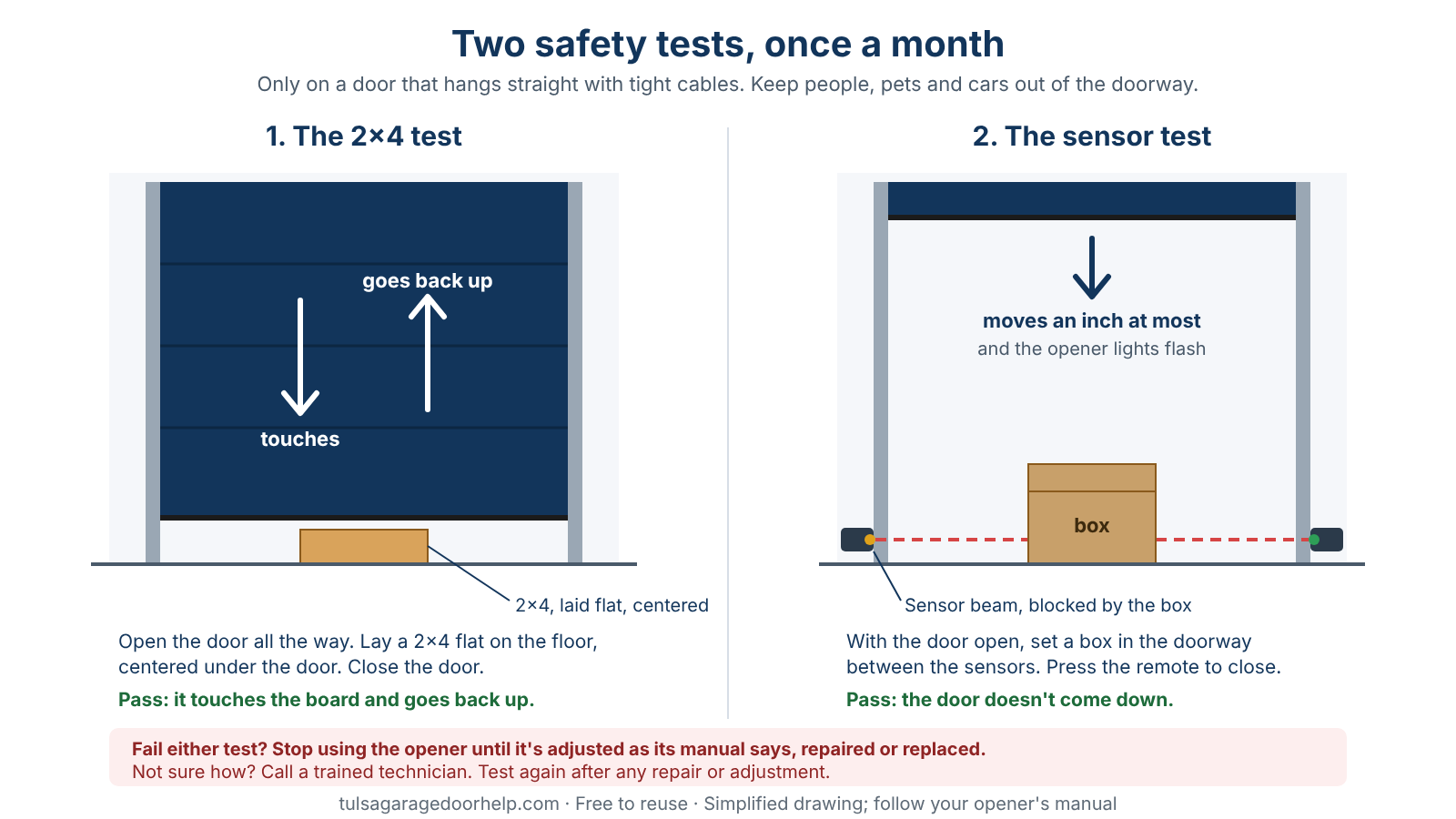
- After any change, check the door reverses off a 2x4 laid flat on the floor.
- Call a technician if a track is bent, the door still reverses at the same height or it fails the 2x4 test.
Don't
- Never use the force setting to overcome a sticking door.
- Red release cord: only with the door fully closed. Never with a broken spring, loose cable or crooked door.
Battery backup? An opener with a backup battery can still run the door when it is unplugged. Keep everyone clear of the door and keep the remotes out of reach. Your opener's manual says how to disconnect the battery.
Typical price
If it's the most likely cause: Most repairs: typically $98–$371 (across all repairs, including big ones: $98–$860). Source: This Old House, updated May 29, 2026.
If it turns out to be one of the others:
- Often free: you can usually sort this yourself.
- Opener repair: typically $124–$368 (average $234). Source: HomeAdvisor (no date shown).
National figures, not a quote. Every price range and its source.
Good to know: Opener lights flashed, or only now and then? Something broke the beam of the safety sensors (the two small boxes near the floor): see The door won't close and the opener lights flash or blink.
Step by step: How to lubricate a garage door (and which lubricant to use)
Photos that help
These three photos help a shop quote it in writing:
- Both small sensors near the floor, with their lights showing
- The opener, with any light that is flashing
- The door where it stops
Take them from where you stand. Don't go under the door, and don't touch the springs, cables or tracks. How to send them.
Where this comes from (4 sources)
- Chamberlain 8200 1/2 HP User Manual, page 35 (Having a problem?), Chamberlain owner's manual (copy hosted by ManualsDir)
- Garage Door Opener Diagnostic Codes, Chamberlain Group (LiftMaster, Chamberlain and Craftsman support)
- Garage Door Only Travels a Little Way and Then Reverses, Chamberlain Group (LiftMaster, Chamberlain and Craftsman support)
- My Garage Door Will Not Fully Close, Chamberlain Group (LiftMaster, Chamberlain and Craftsman support)
We read each source on 10 November 2026. The order of causes follows the makers' own troubleshooting pages where they give one; otherwise it is our judgment, and the page says so.
Not quite it? Describe your problem
Describe it in your own words, like "goes back up" or "remote stopped working".
Related problems
- The door won't stay closed and ends up open again later
- The door reverses or won't close only when it's cold
- The remote or keypad won't close the door, but holding the wall button does
- The door starts to close, then goes back up
- The door won't close and the opener lights flash or blink
- The door closes partway and just stops
Got a quote that feels high?
Text the amount and what it covers to (918) 205-5200. We compare it with published price data (the sources on our price page), and text you back within a business day. Free, no obligation, and we don't repair doors.
Diagram: Two monthly safety tests: the 2x4 test and the sensor test