The garage is freezing in winter or an oven in summer
The likely cause, a quick check, what's safe to do, and what it usually costs.
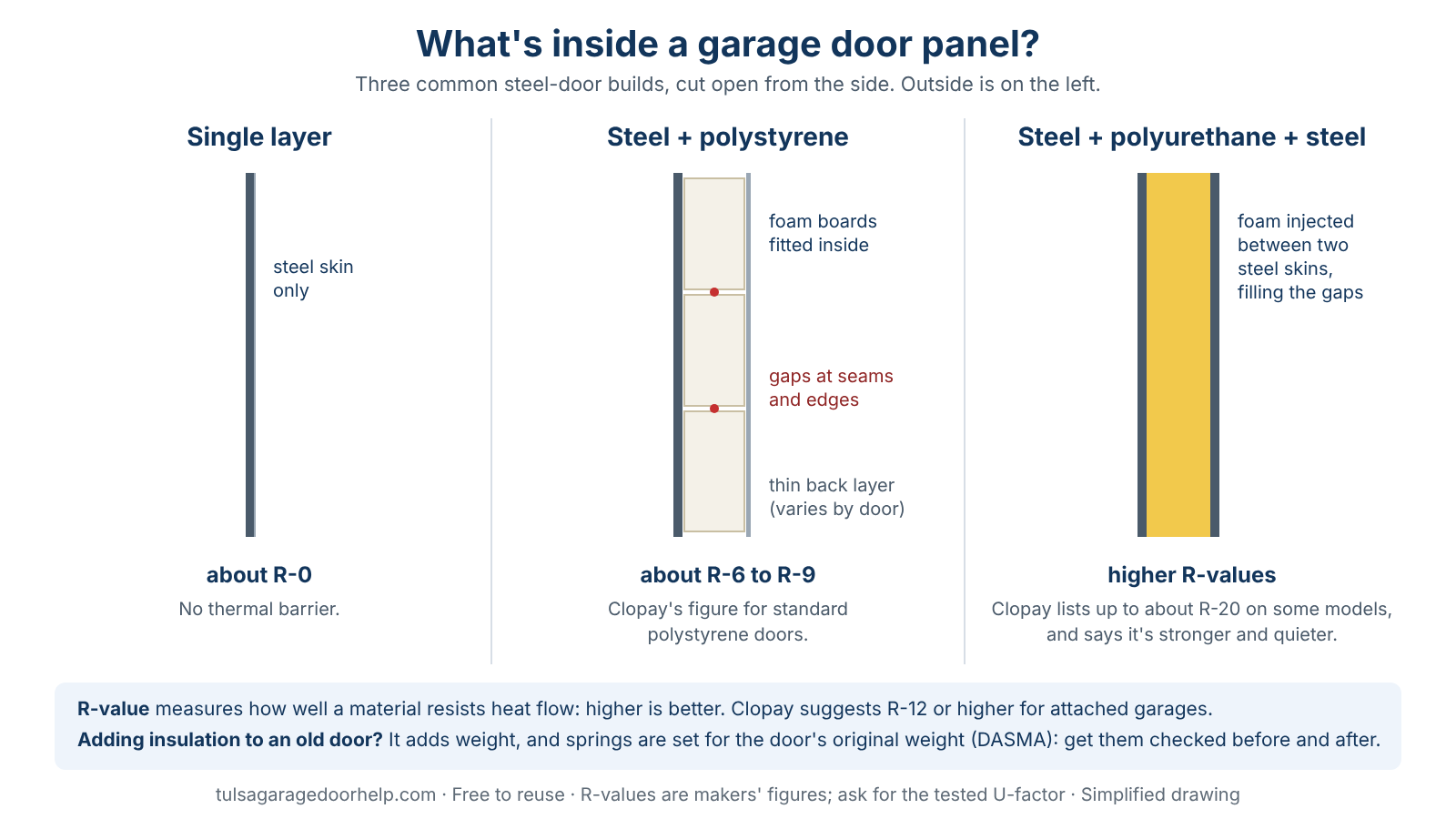
Most likely: Door has no insulation (single-layer steel)
Clopay says a non-insulated door leaves the garage hot in summer and cold in winter.
This one needs a garage door company.
Also possible
- Air leaking past worn bottom, side and top seals. With the door shut, look for daylight and feel for drafts along the bottom, sides and top. DIY first
- Insulated door, but lower performing than its label suggests. Find the door's model label and ask the maker for the tested U-factor, not just the section R-value. Needs a pro
Safe to do now
- Check and replace worn seals first, before thinking about a new door.
- Find out if your door is insulated by looking at its inside face.
- When comparing new doors, ask for the tested U-factor (lower is better) as well as R-value.
- Before adding an insulation kit, check with the door's maker (DASMA advises against attaching anything without the maker's instructions), and have the door balance checked afterwards.
Don't
- Do not add insulation, panels or boards to the door without having the springs checked; it adds weight.
- Do not compare one maker's section R-value to another's tested U-factor.
Typical price
If it's the most likely cause: New door, installed: typically $1,093–$1,674 one-car, $2,186–$3,348 two-car (standard installation). Source: This Old House, updated Mar 13, 2026.
If it turns out to be one of the others:
- Most repairs: typically $98–$371 (across all repairs, including big ones: $98–$860). Source: This Old House, updated May 29, 2026.
National figures, not a quote. Every price range and its source.
Photos that help
These three photos help a shop quote it in writing:
- The gap or the worn seal with the door closed
- The bottom corner of the door from inside
- The whole door from outside
Take them from where you stand. Don't go under the door, and don't touch the springs, cables or tracks. How to send them.
Where this comes from (6 sources)
- Insulated vs Non-Insulated Garage Doors, Clopay
- How to Keep Your Garage Warm in the Winter and Cool in the Summer, Clopay
- Garage Door Seals - A Buyer's Guide, Clopay
- TDS 163: U-factor and R-value, DASMA (Door & Access Systems Manufacturers Association)
- DASMA Technical Data Sheet #176, DASMA (Door & Access Systems Manufacturers Association)
- DASMA Technical Data Sheet #190, DASMA (Door & Access Systems Manufacturers Association)
We read each source on 10 November 2026 (DASMA TDS 176 and 190 on 17 November 2026). The order of causes follows the makers' own troubleshooting pages where they give one; otherwise it is our judgment, and the page says so.
Not quite it? Describe your problem
Describe it in your own words, like "goes back up" or "remote stopped working".
Related problems
- Rain leaks in at the top, between the sections or around the windows
- The inside of the door is wet with condensation, frost or mold
- The door is frozen to the ground and will not lift
- There is a gap or daylight under the door, often on one side only
- The bottom seal sticks to the floor when it is not icy, and the door jerks free
- Wasps are nesting on the door or opener, or snakes are getting in around the door
Got a quote that feels high?
Text the amount and what it covers to (918) 205-5200. We compare it with published price data (the sources on our price page), and text you back within a business day. Free, no obligation, and we don't repair doors.
Diagram: Garage door weather seals: where each one goes
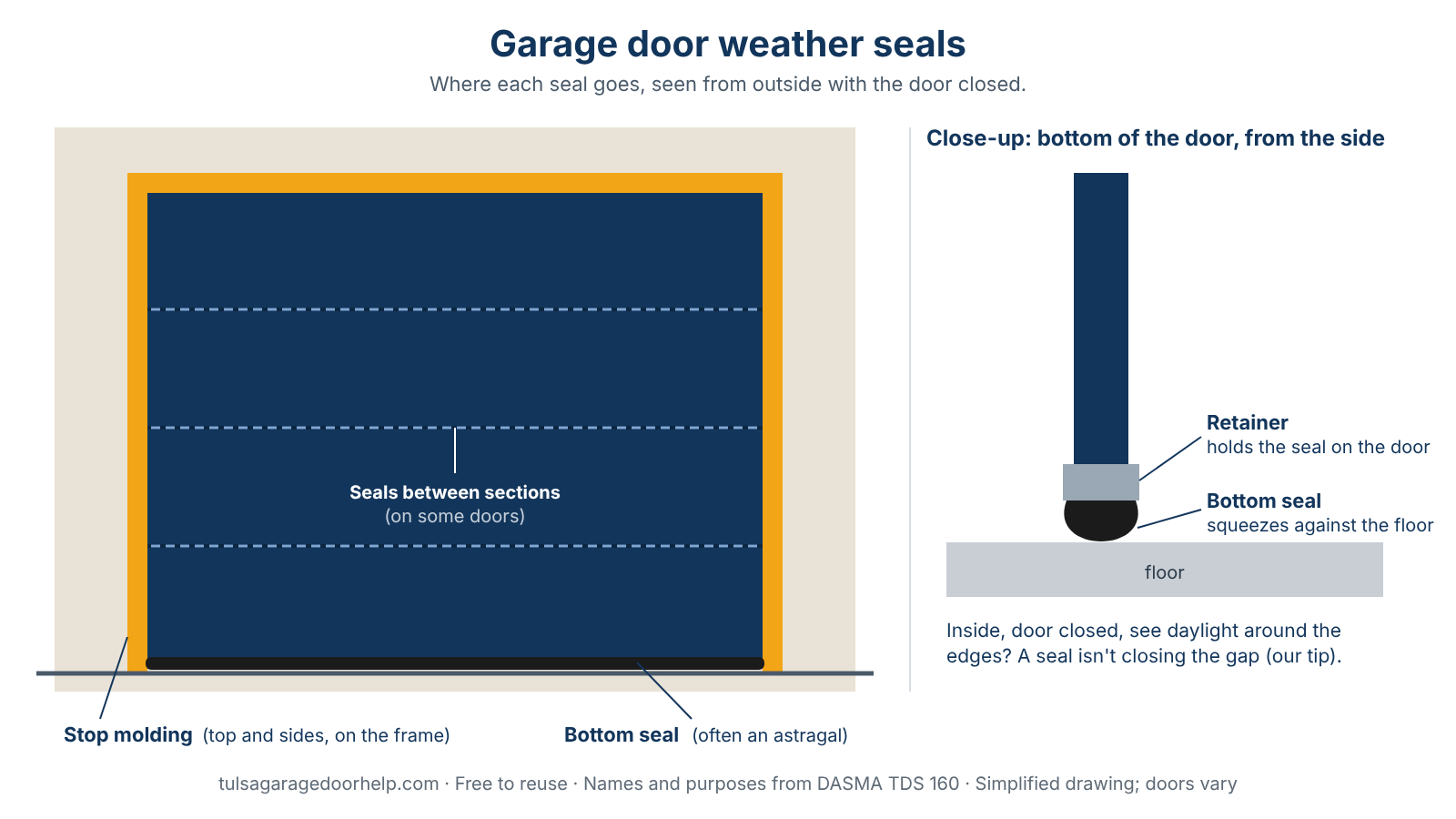
Diagram: Insulated vs non-insulated garage doors: what's inside the panel